

Nutrition of Göttingen Minipigs. A study of the influence of ad libitum and restricted feeding on the physiology of the Göttingen minipig
By Bollen, Peter J.A.
| Record number: | c6d6d (legacy id: 6982) |
|---|
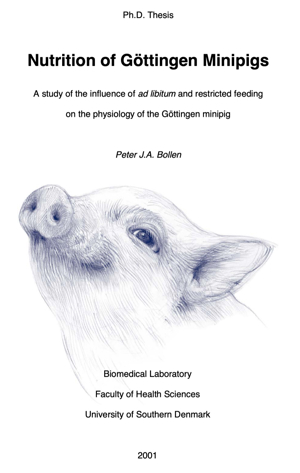
Minipigs are accepted as a research animal in biomedical research, and are amongst others used as non-rodent species in drug development and toxicology. The Göttingen minipigs was developed for approximately 40 years ago at the University of Göttingen, and has been bred at full-barrier facilities in Denmark since 1993, for securing a microbiological defined quality. Genetically and microbiologically the Göttingen minipig is well defined, but feeding has been based on best practical experience. Nutrition can have a large influence on the physiology of minipigs, e.g. feeding a high-fat diet can induce atherosclerosis and diabetes. This PhD-thesis has therefore focussed on the nutrient requirements and feeding practice of minipigs, both for preventing obesity and for preventing (marginal) nutrient deficiencies. In conclusion, large sex differences were found. The body weight of females became much larger than that of males at ad libitum feed intake. This was mainly due to large differences in body fat reserves. Females became grossly obese at ad libitum feed intake. Restricted feeding at different levels showed that obesity in females was prevented by meal feeding at approximately 40% of voluntary feed intake, without the occurrence of symptoms of deficiencies. Males fed at approximately 60% of voluntary feed intake had very low body fat reserves, and therefore this feeding level was considered insufficient for males. A feeding level of 100% of voluntary feed intake (near ad libitum) resulted in a body weight similar to that of females fed at 40% of voluntary feed intake. Minipigs are characterized by a reduced lean body growth capacity as compared to large pigs, and therefore nutrient requirements of pigs cannot be applied to minipigs. The specific energy expenditure per kg lean tissue is approximately twice as high than in humans. The project has shown that minipigs are interesting research models for obesity research. Females easily develop obesity when fed ad libitum. This project indicated that minipigs also are sensitive to dietary fat induced pathological changes, such as serous atrophy of the bone marrow and changes in thrombocyte characteristics, but further research is needed in these areas.
Table of Contents:
Preface; Acknowledgements; List of Publications; Abbreviations; Introduction; Materials and Methods; Results; Discussion; Conclusions; References; Summary; Summary in Danish; Appendices; Publications.
Ph.D. Thesis. 364 pages. Softcover.
ISBN number: 87-90923-20-0.
Year: 2001
Takk for din tilbakemelding! Vær oppmerksom på at vi ikke kan kontakte deg hvis ikke du oppgir din epostadresse.
Hva lette du etter?
Gi oss gjerne en tilbakemelding slik at vi kan forbedre informasjonen på siden. På forhånd takk for hjelpen! Vennligst skriv inn din epostadresse hvis du vil ha et svar.
Kontakt oss gjerne på e-post hvis du har spørsmål.