

Statistical experiment design for animal research
By Sorzano, Carlos Oscar S.
| Record number: | e8fdd |
|---|
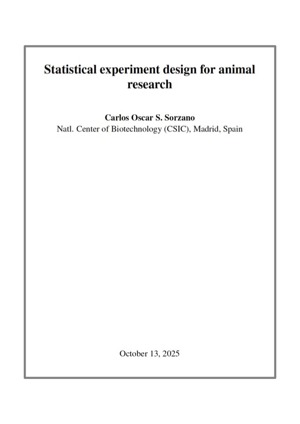
This book focuses on the tools needed to manage experimental noise and sample size, as well as avoiding bias—covering all essential steps prior to conducting the experiment. It does not address post-experimental data analysis. Using real biomedical examples and highlighted "Important remarks," the text balances the mathematical complexity of statistics with practical laboratory applications. Ultimately, this book underscores that while not every researcher must become a statistical expert, scientific rigor and ethical standards—especially regarding experiments involving living beings—require either a strong statistical foundation or active multidisciplinary collaboration.
In biomedical research, the statistical approach to experimentation is divided into two distinct phases: pre-experimental planning and post-experimental analysis.
Following data collection, researchers utilize statistical inference to isolate the underlying biological signal from confounding noise, such as measurement errors and biological variability.
Whether we detect the sought-after effect depends on three distinct factors: The actual existence of a biological effect (e.g., whether the drug is truly effective). The magnitude of the noise within the measurements. The amount of evidence collected, determined by the sample size (how many times the difference is observed). From a statistical standpoint, researchers cannot alter the first factor. However, factors 2 and 3 can be optimized beforehand.
Crucially, experimental design cannot be separated from data analysis; researchers must anticipate how the data will be analyzed prior to conducting the experiment.
To guide researchers through this interdependent process, this book is structured into two main parts:
- Factor 2 (Noise reduction) is addressed through statistical experimental design, which systematically identifies and controls external sources of variation (e.g., age, sex, or methodology) to minimize unexplained noise. Part 1 of the book offers an intuitive, conceptual overview of these designs and potential pitfalls, while Part 2 explores the underlying mathematical rationale.
- Factor 3 (Evidence and sample size) is addressed through sample size calculations, determining how many replications are required to confidently confirm a biological effect.
Contents:
- Why do we need a statistical experiment design?
- Real experimental examples
- Statistical pitfalls
- Sample size calculations
- Design of experiments
This book may be read as a pdf file here.
296 pages.
Year: 2025
Takk for din tilbakemelding! Vær oppmerksom på at vi ikke kan kontakte deg hvis ikke du oppgir din epostadresse.
Hva lette du etter?
Gi oss gjerne en tilbakemelding slik at vi kan forbedre informasjonen på siden. På forhånd takk for hjelpen! Vennligst skriv inn din epostadresse hvis du vil ha et svar.
Kontakt oss gjerne på e-post hvis du har spørsmål.