

XeMo, the substitute Xenopus Model
| Record number: | 6312a |
|---|---|
| Category: | Education and training |
| Type: | Simulator |
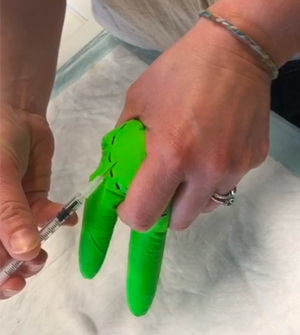
XeMo is a virtual model of the Xenopus frog that serves as a substitute for using live animals in practical training and education. Developed by researchers, this tool uses a digital approach to provide hands-on educational experiences, which has significantly reduced the need for live animals in labs and received acclaim from organizations such as the French 3R Centre (FC3R). XeMo can be used to practise restraint, to correctly position the hand and fingers relative to the Xenopus' hind legs. This model can also be used to explain where and how much pressure to apply to obtain eggs by squeezing, which requires dexterity and practice to avoid harming reproductive function. Can be used several times even when the inner glove is pierced, as pressure must be applied to check for liquid loss.
Nathalie Malirat (Institute of Human Genetics), Marie-Elise Schwartz (TPS-AQUA), Aurélien Drouard (Institute of Functional Genomics), and Abdelkrim Mannioui (Institute of Biology Paris-Seine), who work with aquatic species and participate in regulatory training for animal experimentation, have together developed XeMo.
Watch the XeMo manufacturing video: https://youtu.be/foGushKykEM
Anyone - in their animal facility, training program, university, or elsewhere - can set this up easily, quickly, and at very low cost, using items commonly found in laboratories:
- 1 nitrile glove size M
- 1 nitrile glove size L (preferably green)
- 200 mL of tap water
- and 0.1 g of Ponceau red dye (optional)
To make a XeMo, take a size M glove, tie knots in the thumb, middle, and little fingers and tuck them inside, then fill the glove with 200 mL of water (with or without Ponceau red) and tie a knot at the wrist. The index and ring fingers, now filled with liquid, resemble the posterior part of a Xenopus. Then slip it into a size L glove (with the thumb, middle, and little fingers also knotted and tucked in), and tie it at the wrist, leaving a little air between the two glove layers to mimic the space representing the dorsal lymphatic sac. The index and ring fingers, filled with liquid, now resemble the posterior part of a Xenopus. The XeMo is ready.
Takk for din tilbakemelding! Vær oppmerksom på at vi ikke kan kontakte deg hvis ikke du oppgir din epostadresse.
Hva lette du etter?
Gi oss gjerne en tilbakemelding slik at vi kan forbedre informasjonen på siden. På forhånd takk for hjelpen! Vennligst skriv inn din epostadresse hvis du vil ha et svar.
Kontakt oss gjerne på e-post hvis du har spørsmål.