|
Newsletter no. 6-2025 from Norecopa
Welcome to Norecopa's sixth newsletter of 2025. This is the 131st newsletter which we have issued.
We hope you find them of use. We
welcome feedback, positive or negative.
Please share this newsletter with your colleagues and friends, and encourage them
to subscribe!
We are also on
LinkedIn and (to a much lesser extent) on
Facebook.
This newsletter contains the following items (if some links do not appear to work, check that your mail program has opened the whole of the newsletter):
|
•
|
|
|
•
|
|
|
•
|
|
|
•
|
|
|
•
|
|
|
•
|
|
|
•
|
|
|
•
|
|
|
•
|
|
|
•
|
|
|
•
|
|
|
•
|
|
|
•
|
|
|
•
|
|
|
•
|
|
|
•
|
|
|
•
|
|
|
|
|
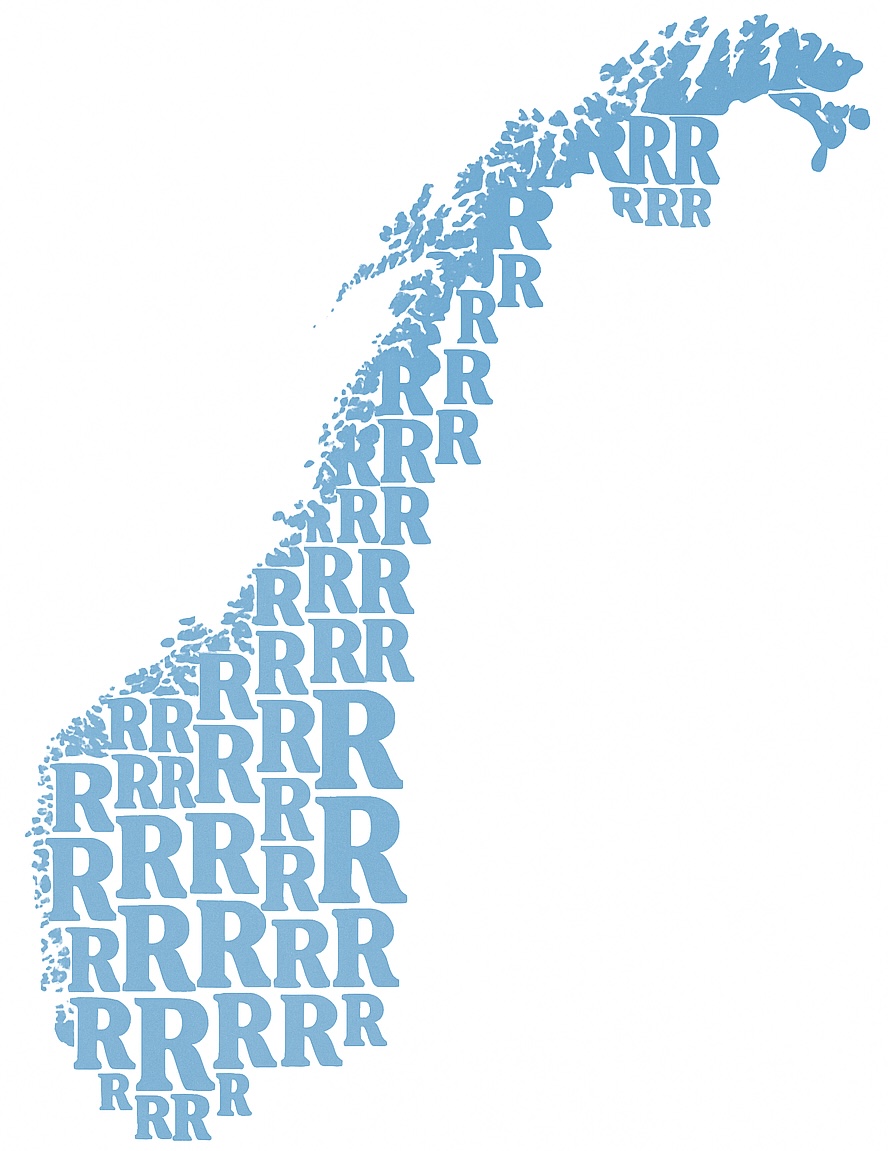
On 3 December the political parties in Norway that form the Parliamentary majority reached an agreement on next year's State Budget. They have allocated 6 million Norwegian kroner (510,000 euros) to 'strengthen work on alternatives to animal experiments'. The money has been allocated to the Veterinary Institute, where Norecopa is situated.
The details about how this money is to be used have yet to be discussed, but this will strengthen nationwide efforts to further all "the
three Rs" (Replacement, Reduction, Refinement), involving all 80 research animal facilities and their work with lab, farm, fish and wildlife species.
There remain a number of steps in this process: a debate in Parliament (19 December), conclusions from an ongoing evaluation by the Ministry of Agriculture and Fisheries on Norway's 3R efforts and discussions which will involve the Norwegian Veterinary Institute and all relevant collaborative partners, when the Institute receives its final
budgetary instructions from the Ministry.
Illustration: ChatGPT
|
|
Many will have missed the webinars organised by Rafael Frías while he worked at Karolinska Institute. Between 2020 and 2024 he organised 91 webinars with leading experts in the field, that attracted over 21,000 attendees. We are now resuming these webinars under the umbrella of Norecopa and in collaboration with his new company, R3FINED Ltd.
The webinars will follow the topics in
Annex V of
Directive 2010/63/EU and the learning outcomes of the
EU Education & Training Framework. Each webinar focuses on a key topic in LAS: ethics and the 3Rs, species biology and care, pain recognition and alleviation, humane endpoints, refinement of techniques, anaesthesia, surgery, experimental design, and good scientific practice. The aim is to offer knowledge which attendees can actually use, with time to interact and ask
questions.
The format will consist of 40-minute presentations followed by 20 minutes for discussion, with a strict 60-minute limit.
More information about the webinars
is available here. The first one is on 29 January, when Dr. Sally Thompson-Iritani, University of Washington, Seattle will introduce the series with the topic
Animal Research at a Crossroads: Strengths, Weaknesses, and the Path Forward.
|
|
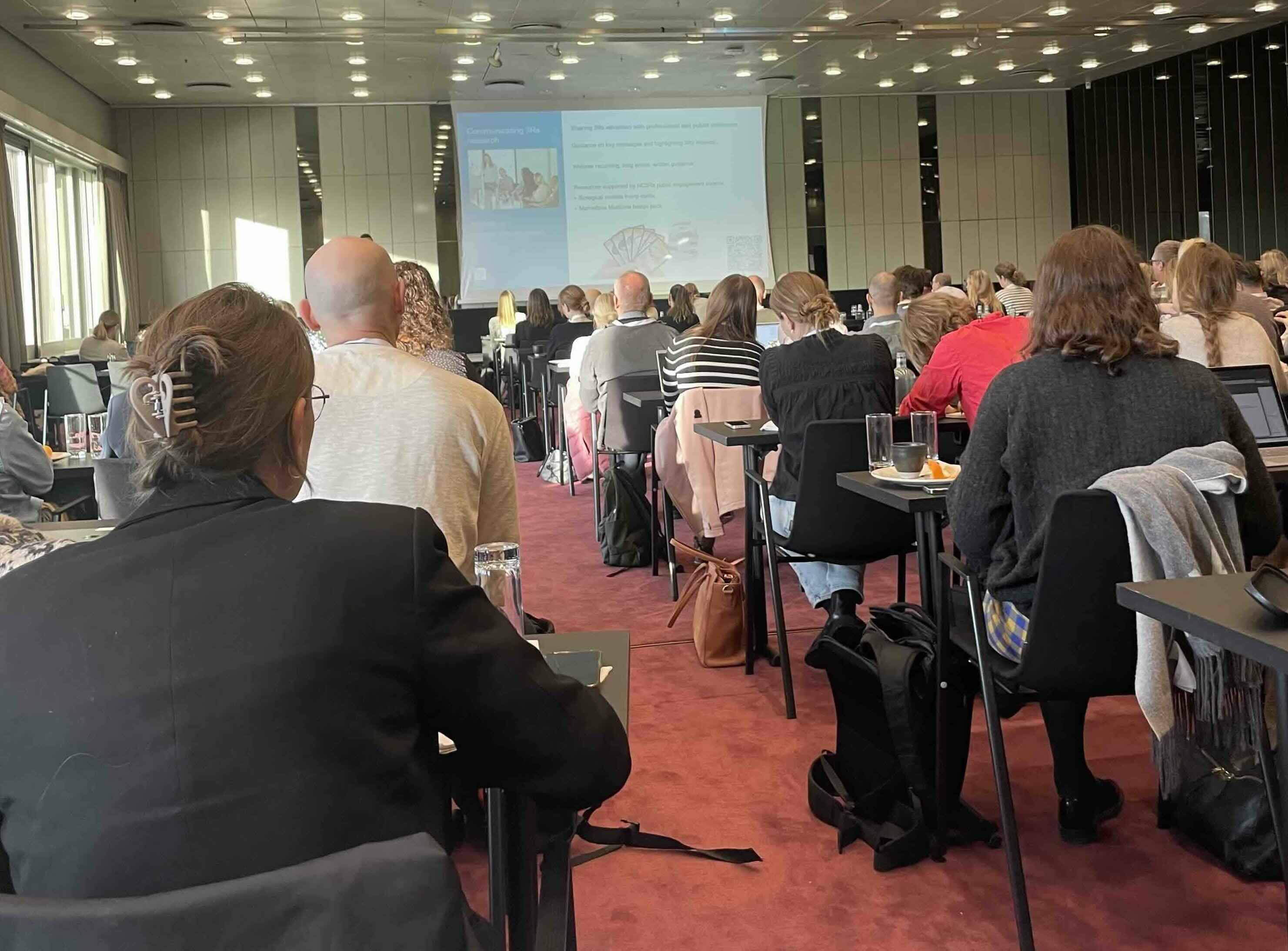
On 2 December the second General Assembly of the year for
ecopa (European Consensus-Platform on Alternatives) was held in Bologna and online. The object of the Assembly was to decide the fate of the organisation.
Ecopa was founded in 1999, at a time when there were frequent violent attacks on those involved in animal research and testing. Its aim was to promote dialogue and seek consensus between the four stakeholders - regulators, industry, scientists and animal welfare - and to encourage the
foundation of
National Consensus Platforms (NCPs), one per country, which had representatives of all four parties in their governing body.
Since then, many 3R centres have been established, but relatively few of these satisfy the conditions for membership of
ecopa, and several of those that did have closed for various reasons. By 2025 there were only
7 NCPs affiliated to
ecopa (in Finland, France, Germany, Italy, Norway, Spain & Switzerland), while there are approximately
thirty 3R centres in Europe. Many of these have taken over the work for which
ecopa was designed. The organisation’s finances have also gradually dwindled over the years, not least due to the high costs of registering an international organisation in Belgium.
The General Assembly voted therefore unanimously to close
ecopa, and to use the remaining capital for efforts to educate young scientists in the 3Rs.
Norecopa's Secretary, who was present in Bologna as a Board Member, thanked all those who have contributed to
ecopa's work. Norecopa will continue to promote the quadrapartite principle through its name and through involvement of all four parties in its work, in a spirit of consensus.
The Board plans to publish a paper summarising the work of
ecopa over the last 25 years.
|
|
This week we were saddened to hear that
the Danish 3R-Center will be closing down at the end of this year, due to extensive cuts in the budget of the Danish Veterinary and Food Administration, where the Center’s secretariat is situated.
The seven members of the Center’s Board will continue to function as Denmark’s National Committee for the Protection of Animals Used for Scientific Purposes – a committee which all EU Member States are obliged to have. But this means that the duties
performed by the Center, which we have learned to appreciate highly, will cease. These include their annual
3Rs Symposium which has attracted around 200 scientists each year for the last 10 years,
a newsfeed of global 3R advances and monetary support of
Danish 3R research projects since 2014. The National Committee will continue to arrange its
annual meetings for Denmark’s Animal Welfare Bodies.
Denmark’s 3R-Center has been an active member of several international networks including
the Togeth3R Consortium and
EU3Rnet. Indeed, it was one of the Center’s staff members, Rasmus Normann Nielsen, who constructed and now manages the EU3Rnet website.
Norecopa regrets this decision to cut off funding to a resource which had achieved a prominent and highly useful role in the international 3R community. Norecopa's Secretary Adrian Smith had the pleasure of serving on the Board of the Center and on the National Committee for 8 years, from their foundation in 2013
until 2021.
We hope that the means will somehow be found to rekindle this activity in Denmark.
|
|
The Danish 3R-Center arranged another excellent annual
3R Symposium in Copenhagen on 20-21 November. Many of the presentations are available in
pdf form. Norecopa's Secretary had a poster at the Symposium on
Preparing for Better Science, which may be used freely.
FELASA is creating a new platform to share information and good practice on rehoming. This will help the establishments new to rehoming and it could also inspire others, trigger discussion and collaboration, stimulate creativity, and improve practices further, all to the common goal of better animal welfare. The platform will list information per species on, for example, socialisation protocols, SOPs on preparing the animal to the outside world, transport conditions,
screening of suitable homes, meeting the new home's owners in a staged process, ethical approval schemes, forms to discharge animals from the laboratory animal regulation, and follow-up systems after rehoming. The website will only list species, country and a code number. Interested parties can then contact FELASA.
Those who are already rehoming and are keen on sharing information on their processes are
requested to take FELASA's survey to help them populate their database on rehoming.
The
Swedish 3R-center has translated its
advice on refined methods for handling habituation and training of laboratory rodents and fish into English.
The accreditation organisation
AAALAC International has created
a presentation series, aimed at the various roles in an animal facility, to help prepare for a site visit. This year AAALAC also released
guidance on accreditation of field research. Norecopa is a member of AAALAC but has not taken part in the development of these resources.
|
|
Scientists and animal care staff in Norway should consider nominating themselves or colleagues for
Norecopa's annual 3R Prize. Established in 2010, the prize consists of NOK 30,000 and a diploma. The deadline for nominations is 15 March. Previous winners are
highlighted here.
Since the last newsletter, Adrian Smith has attended the Danish 3R symposium (mentioned earlier) and a
conference for Norwegian Animal Welfare Bodies at Gardermoen on 20 November organised by Norway's National Committee. The subject of this meeting was Replacement, for which he held a
short presentation. Breakout discussion groups were arranged for those working with the different groups of species, which gave valuable time for discussion.
He is on the
Scientific Committee of the
Austrian 3R Days to be held in Vienna on 28-30 April.
We thank
Charles River for their recent generous donation of $15,000 towards the work of Norecopa.
|
|
The
Research Animal Anaesthesia Network (RAAN) exists to promote and support the involvement of veterinary anaesthetists in experimental research involving animals.
It aims to achieve this in the following ways:
• Fostering collaboration between experienced laboratory animal anaesthetists and scientists requiring assistance or advice in animal anaesthesia and analgesia;
• Hosting a discussion
forum and mailing list for members of the network to share ideas, experience and information related to veterinary anaesthesia and analgesia in a research context;
• Building a community of veterinarians interested in experimental refinement through anaesthesia and analgesia;
• Facilitating multi-centre research.
RAAN also maintains a Discourse Site where members can discuss anaesthesia and analgesia protocols. This is in the spirit of
Norecopa's own Refinement Wiki.
RAAN is led by an Executive Committee that exists as a subcommittee of the
Association of Veterinary Anaesthetists (AVA). RAAN was launched at the AVA meeting in Vienna in May 2025.
The
RAAN Executive Committee maintains a list of veterinarians, with acumen in veterinary anaesthesia in experimental settings, who are willing to provide assistance and advice to researchers. The target group of researchers is primarily those involved in biomedical research but extends to anyone.
|
|
EU's Reference Laboratory
EURL ECVAM has launched
BimmoH, the largest dataset of scientific article references making use of human biology-based models.
BimmoH consolidates information on a wide range of models based on human biology, including organ-on-a-chip technologies, 3D cell cultures, and computational models. It uses machine learning techniques to analyse millions of papers, automatically identifying and organising references to human
biology-based research methods.
The result is a comprehensive, curated collection of hundreds of thousands of resources that can significantly reduce research time and accelerate innovation. Beyond academia, BimmoH should be of value to regulators, policymakers, funders, and industry stakeholders.
|
|
On 9 December there was a webinar about the
Share-it 3Rs project, coordinated by
Magda Czubala at Cardiff University.
The project aims at making live animal and animal tissue sharing globally effective and participatory. It is mapping existing approaches into a coherent pipeline, exploring potential interlinkages, and developing new alternatives where necessary. Share-it focuses on 2 main pillars of sharing: within institutions and between institutions, including biobanks and similar initiatives.
A recording of
the webinar
is available here.
|
|
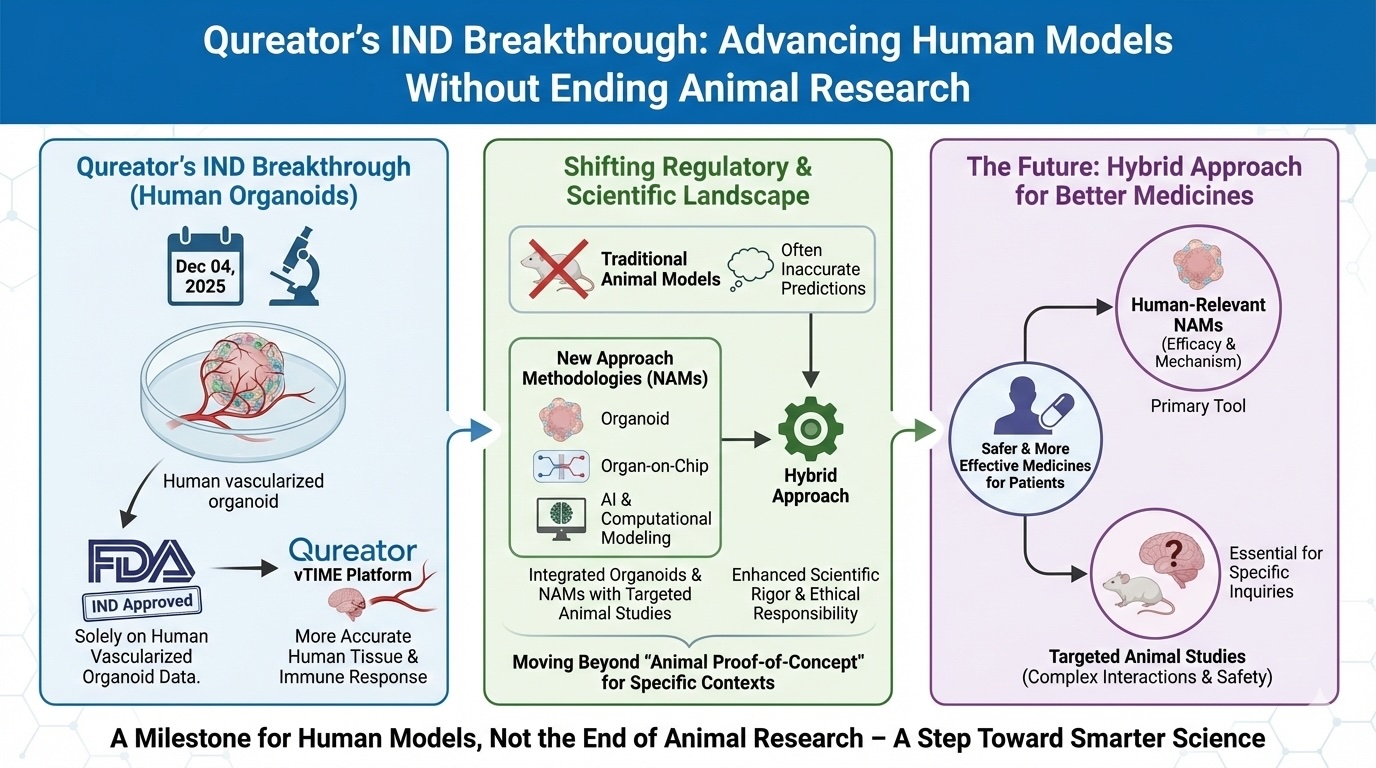
Stefano Gaburro comments upon
the registration of a new oncology drug combination, illustrating the increasing regulatory confidence in models mimicking human tissue and immune responses.
He concludes that the evolving landscape favours a hybrid approach that integrates organoids and other new methodologies with targeted animal studies to enhance scientific rigor and ethical responsibility. This
shift signifies progress toward more accurate, efficient, and humane drug development, while also acknowledging that animal research remains essential for certain inquiries.
|
|
Moral judgements on biomedical research must embrace complexity, according to Michele Basso at the University of Washington. She writes: The moral revolution that biomedical research needs is one that acknowledges complexity, embraces judgement and treats scientists not as villains to be restrained, but as partners in ethical progress that benefits us all.
We
recognise the value of animal experimentation, but we recognise the values of animals as well. Edwin Louis-Maerten and colleagues have gained insight into the conflicting experiences of researchers in their efforts to implement the 3Rs in Switzerland.
Brent Vasquez and colleagues discuss
the ethical, robust and practical use of AI in animal research. They describe a repeatable approach using Generative Artificial Intelligence to improve the quality and speed of Institutional Animal Care and Use Committee reviews, while considering issues of ethics, bias, robustness and trustworthiness. They implemented theirr system for 11 different common errors and found every actual problem (100% recall) in the animal
protocols with 80–100% precision.
Cristina Priboi and Hanno Würbel's group have looked at researchers' perspectives on
preregistration in animal research. They have also conducted
a feasibility study to improve the uptake of the method in Switzerland.
How can the publication of negative results be incentivised?
Stephen Curry and coworkers offer some guidance.
Greek scientists have conducted a survey
to investigate the integration of alternative methods in research and educational institutions in the country's 56 facilities. 62.5% of the 50% who responded had partially substituted animal models, with cell cultures, Systematic Review and/or Μeta-Αnalysis, and other non-animal methods being the major adopted methods. The main finding of our survey was the established perception that scientific
reproducibility, time efficacy of research out-comes, and moral integrity are adequately guaranteed by adopting alternative methods to animal use. However, until more validated alternatives are present and widely accessible, the use of animals in biomedical research and education in Greece is still imperative.
Nuno Franco, Otto Kalliokoski and Vootele Voikar have shared their insights and personal reflections from one of the largest meetings in lab animal science in 2025:
the FELASA congress in Athens.
The outcomes of a hybrid symposium on 'Evaluating translational value of animal models in preclinical research - Tools, challenges, and strategies’, held in June/July this year have now been published by Francesca Pistollato and colleagues.
Clinical veterinary students are likely
to be more confident and competent in calving procedures after blending simulator practicals with videos. The implications for training in procedures related to animal research are obvious.
An essay by Mark Yarborough
asks why too much biomedical research is often undeserving of the public's trust.
"95% of drugs that work in animals fail in humans":
Stefano Gaburro walks the reader through the data and its causes, which is essential to understand how we should relate and react to this claim.
|
|
Bevilgningen på 6 millioner for 'å styrke arbeid med alternativer til dyreforsøk', nevnt øverst i dette nyhetsbrevet, er omtalt
her på Stortingets nettsider under "Hovedtrekk og prioriteringer for 2026".
Tallet ble først presentert i
budsjettforliket mellom Ap, Sp og Rødt, og ble stående der da
MDG og SV også kom til enighet om budsjettet. Bevilgningen var ikke nevnt i Regjeringens "gul bok" (Prop. 1S om statsbudsjettet, sist redigert 12.11.25).
Etter budsjettforliket er det derimot omtalt i
innstillingen til statsbudsjettet for 2026 fra
Næringskomitéen. Under
kapittel 1135, post 50, Veterinærinstituttet (Kunnskapsformidling, formidling og beredskap), står det:
Komiteens flertall, medlemmene fra Arbeiderpartiet, Sosialistisk Venstreparti, Senterpartiet, Rødt og Miljøpartiet De Grønne, viser til budsjettforliket og Innst. 2 S (2025–2026) der bevilgningen på kap. 1135 post 50 foreslås økt ytterligere med
6 mill. kroner for å styrke arbeidet med alternativer til dyreforsøk. Bevilgningen kan brukes til realisering av et norsk 3R-senter, dersom det samlet sett gir fornuftig ressursbruk av disse midlene.
Mattilsynet har uttalt seg i klar tekst
om sitt forhold til et eventuelt 3R-senter.
Vi kommer tilbake til saken i det neste nyhetsbrevet, når LMD har offentliggjort sin evaluering av dagens 3R-ressurser, og når Stortinget har behandlet neste års budsjett (19. desember). Saken blir trolig også nevnt i LMDs endelige tildelingsbrev til Veterinærinstituttet. Som nevnt innledningsvis i dette
nyhetsbrevet er det ønske om å involvere alle landets forsøksdyrvirksomheter i arbeidet med å styrke satsingen på 3R.
|
|
Please help us in this task by forwarding this newsletter to friends and colleagues who may wish to subscribe. The white box at the bottom right of every page on Norecopa's website, or this link can be used.
|
|
|
Earlier editions of Norecopa's newsletter can be read here. They were published in Norwegian up to no. 2-2017. Free text searches on
Norecopa's website will also find resources which we have described in newsletters.
Mention in these newsletters of an institution, publication, professional service or opinion on animal research and testing does not necessarily mean that Norecopa endorses the activity or opinion. Norecopa and its staff are not involved, financially or otherwise, in the external activities mentioned here, unless this is explicitly
stated.
|
|
Content:
Norecopa
Editor:
Adrian Smith
Org.no. 992 199 199
Bank account: 2801.53.03931
Vipps: 889149
All photographs in the newsletters have been taken by Norecopa or from
colourbox.com, unless otherwise specified.
You can read about
Norecopa's data protection and privacy policy here.
In compliance with the EU Data Protection Regulation (GDPR), Norecopa updated its personal data and privacy policy in 2018.
You can read about this here.
|
|
|