|
Newsletter no. 1-2026 from Norecopa
Welcome to Norecopa's first newsletter of 2026. This is the 132nd newsletter which we have issued.
We hope you find them of use. We
welcome feedback, positive or negative.
Please share this newsletter with your colleagues and friends, and encourage them
to subscribe!
We are also on
LinkedIn and (to a much lesser extent) on
Facebook.
This newsletter contains the following items (if some links do not appear to work, check that your mail program has opened the whole of the newsletter):
|
•
|
|
|
•
|
|
|
•
|
|
|
•
|
|
|
•
|
|
|
•
|
|
|
•
|
|
|
•
|
|
|
•
|
|
|
•
|
|
|
•
|
|
|
•
|
|
|
•
|
|
|
•
|
|
|
•
|
|
|
•
|
|
|
•
|
|
|
|
As mentioned in our last newsletter, the Norwegian Parliament has allocated 6 million Norwegian kroner (510,000 euros) to 'strengthen work on alternatives to animal experiments'. The money has been allocated to the Veterinary Institute, where Norecopa is situated. There is
more information in Norwegian towards the end of this newsletter. We are currently waiting for directions from the Ministry of Agriculture and Food.
The New Year will therefore be a busy time, discussing how this money can best be used to serve the entire research animal community.
Illustration: ChatGPT
|
|
The response has been overwhelming to our plans to restart a webinar series, in collaboration with Rafael Frías of
R3FINED International.
The format will consist of 40-minute presentations followed by 20 minutes for discussion, with a strict 60-minute limit.
More information about the webinars
is available here. The first one is on 29 January, when Dr. Sally Thompson-Iritani, University of Washington, Seattle will introduce the series with the topic
Animal Research at a Crossroads: Strengths, Weaknesses, and the Path Forward. We have had to close participation in this webinar, as we have over 1,000 registrants. The next one, on 26 February, is open for registration. Thorsten Buch will be discussing how to optimise mouse breeding to save animals, time and money. All those who register will have access to a recording of the webinars, in case they cannot actually attend on the day. We advise early registration!
|
|
The General Assembly of
ecopa (European Consensus-Platform for Alternatives) decided at a special meeting in Bologna on 2 December to close down the organisation during the course of 2026, due to unsustainable funding.
ecopa (spelled with small letters and initials to avoid confusion with other organisations) was established about 25 years ago as a response to the overt aggression towards research animal facilities from the animal rights movement.
ecopa worked to advance the 3Rs, by promoting the recognition of National Consensus Platforms (NCPs) that had representatives for all four stakeholders in their governing body - regulators, industry, scientists and animal welfare - with the aim of striving for consensus about the way ahead for animal research and testing. When Norecopa was founded in 2007, it became Norway's NCP.
There are no plans to change Norecopa's name or composition, despite
ecopa's closure. It was agreed to migrate most of the historical material on
ecopa's website (ecopa.eu) to the
Norecopa site before it is taken down. This will be done by Adrian Smith, who is a Board member.
ecopa has played an important role in encouraging respectful dialogue between stakeholders who may have very differing views about the use of animals for scientific purposes. Norecopa will continue to work to encourage such dialogue in its efforts to advance all three Rs.
|
|
Just before Christmas we were saddened to hear that
the Danish 3R-Center
was to close at the end of 2025, due to major cutbacks in funding of the Danish Food and Veterinary Administration.
Since then, we have been delighted to hear that efforts are being made to rekindle this activity in a different location and with other funders.
The Centre has provided the international research animal community with many valuable resources, not least its
annual symposia, and we wish them the very best for the task of restarting the Centre.
|
|
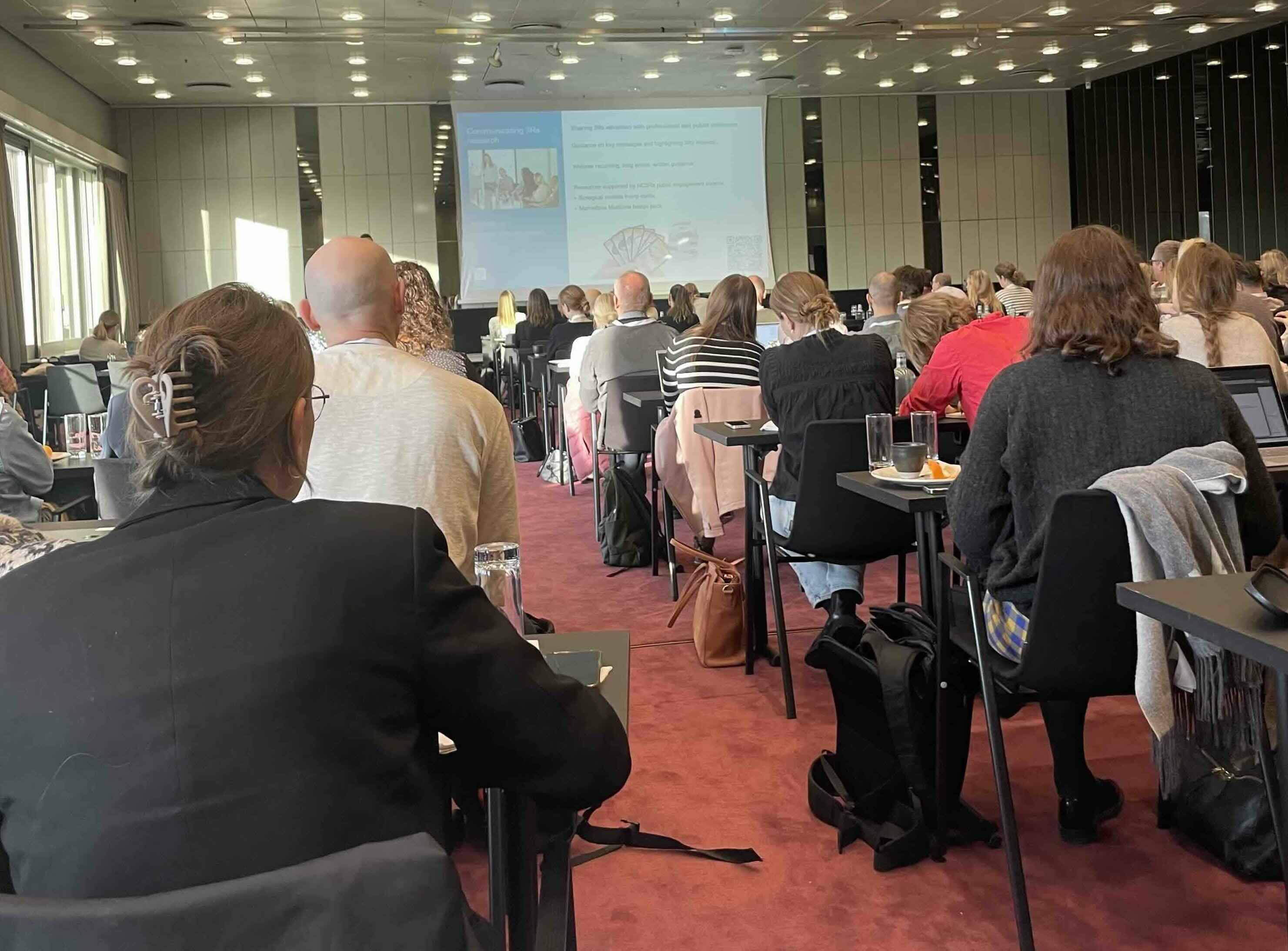
The Danish 3R-Center arranged yet another excellent
symposium in Copenhagen on 12-13 November (illustration), which Norecopa attended with a poster (free to download and use). The slides of many of the presentations are available on their website and are recommended.
The UK Parliament has published a Research Briefing describing
Technology alternatives to animals in life sciences research, explaining how the UK is replacing animal testing with technology alternatives and describing the opportunities, risks and barriers.
The Home Office commissioned the Animals in Science Committee to produce
recommendations for strengthening best practice
in the sector. As part of the work, the Committee published a call for evidence and invited stakeholders to a workshop. The Committee concluded:
The researcher has a responsibility to seek information on leading practice when planning a project. Searching the scientific literature, attending conferences, workshops and training, and using resources primarily from the NC3Rs, but also RSPCA, LASA, IAT and Norecopa, were noted by almost all respondents as methods for seeking
information.
Animal Research Tomorrow have started to publish a
Magazine. Using the motto "By scientists, for Science", they hope it will be a forum for the ideas, perspectives, and stories that resonate within the community. The magazine's columns are open for everyone committed to rigorous, transparent, and ethical animal research.
The Swedish 3Rs Center has published its
Annual Report for 2025 (also available
in Swedish).
The Universities Federation for Animal Welfare (UFAW) has
large (over £5,000) and small (under £5,000) grants available for research projects aimed at developing practical solutions to animal welfare problems. Applications are accepted throughout the year.
AALAS members are invited
to apply for grants ($7,500 or $50,000) to study environmental conditions, pain and stress, health and welfare, euthanasia and other refinement research. This year's deadline is
1 February.
The Alternatives Research and Development Foundation (ARDF) has announced its
2026 Grants Programme, which is designed to fund projects that develop alternative methods to advance science and replace or reduce animal use. Proposals are welcome from any non-profit, non-governmental educational or research institution worldwide, although there is a preference for U.S. applications.
The Swiss 3R Centre has produced a number of short
films for lay people, explaining the 3R concept and their work, and a comic strip (in four languages) about
Culture of Care.
Nominations are now being accepted for the 49th annual
Charles River Prize, which will be presented in Houston at the 77th American Association for Laboratory Animal Science (AALAS) National Meeting in October. The Prize, consisting of a plaque and $3,500, is awarded to a veterinarian in recognition of his/her outstanding contributions to laboratory animal science and medicine.
Horizon Europe has launched the
call of projects ‘Integrating New Approach Methodologies (NAMs) to advance biomedical research and regulatory trials’. The call aims to support the deployment of innovative, human-centred and validated NAMs that
integrate AI and FAIR data. The deadline is 16 April 2026.
In December, Ana Isabel Santos and Nuno Franco
published a summary of the first international
ETPLAS conference, held in March 2025. The meeting gathered course organisers, accreditors, regulators, educators, researchers and animal welfare specialists from across Europe and beyond, who discussed ETPLAS' contributions for advancing education and training in laboratory animal science, as well as its goals for the future.
|
|
Scientists and animal care staff in Norway should consider nominating themselves or colleagues for
Norecopa's annual 3R Prize. Established in 2010, the prize consists of NOK 30,000 and a diploma. The deadline for nominations is 15 March. Previous winners are
highlighted here.
Since the last newsletter, Adrian Smith has attended the Danish 3R symposium (mentioned earlier) and a
conference for Norwegian Animal Welfare Bodies at Gardermoen on 20 November organised by Norway's National Committee. The subject of this meeting was Replacement, for which he held a
short presentation. Breakout discussion groups were arranged for those working with the different groups of species, which gave valuable time for discussion.
He also attended
a Charles River seminar held at the University of Oslo on 21 January. He serves on the
Scientific Committee of the
Austrian 3R Days to be held in Vienna on 28-30 April.
We thank
Charles River for their recent and very generous donation of $15,000 towards the work of Norecopa. This donation is not earmarked to a particular project, so the Board will discuss its use at their next meeting.
|
|
FELASA have published
recommendations for continuous professional development (CPD).
The first step involves creating a CPD portfolio, which the ‘Person(s) Responsible for Training and Competence’ reviews regularly to ensure it aligns with the professional’s personal development plan (PDP). A structured portfolio is proposed for tracking and assessing CPD activities, enabling monitoring. They recommend this monitoring in cycles of up
to 5 years.
FELASA has over the years established many
working groups that produce both guidelines and recommendations.
|
|
MetaDatApp (MAPP) is a metadata platform for preclinical labs working with animal models. It collects experimental entities (projects, cages, treatments, read-outs) and displays them on a graphical interface. The aim of MAPP is to make metadata findable, accessible, interoperable and reusable from day one - boosting reproducibility and accelerating the 3Rs.
|
|
The UK organisation
Understanding Animal Research has published its
Concordat Report on openness around animal research, for 2025.
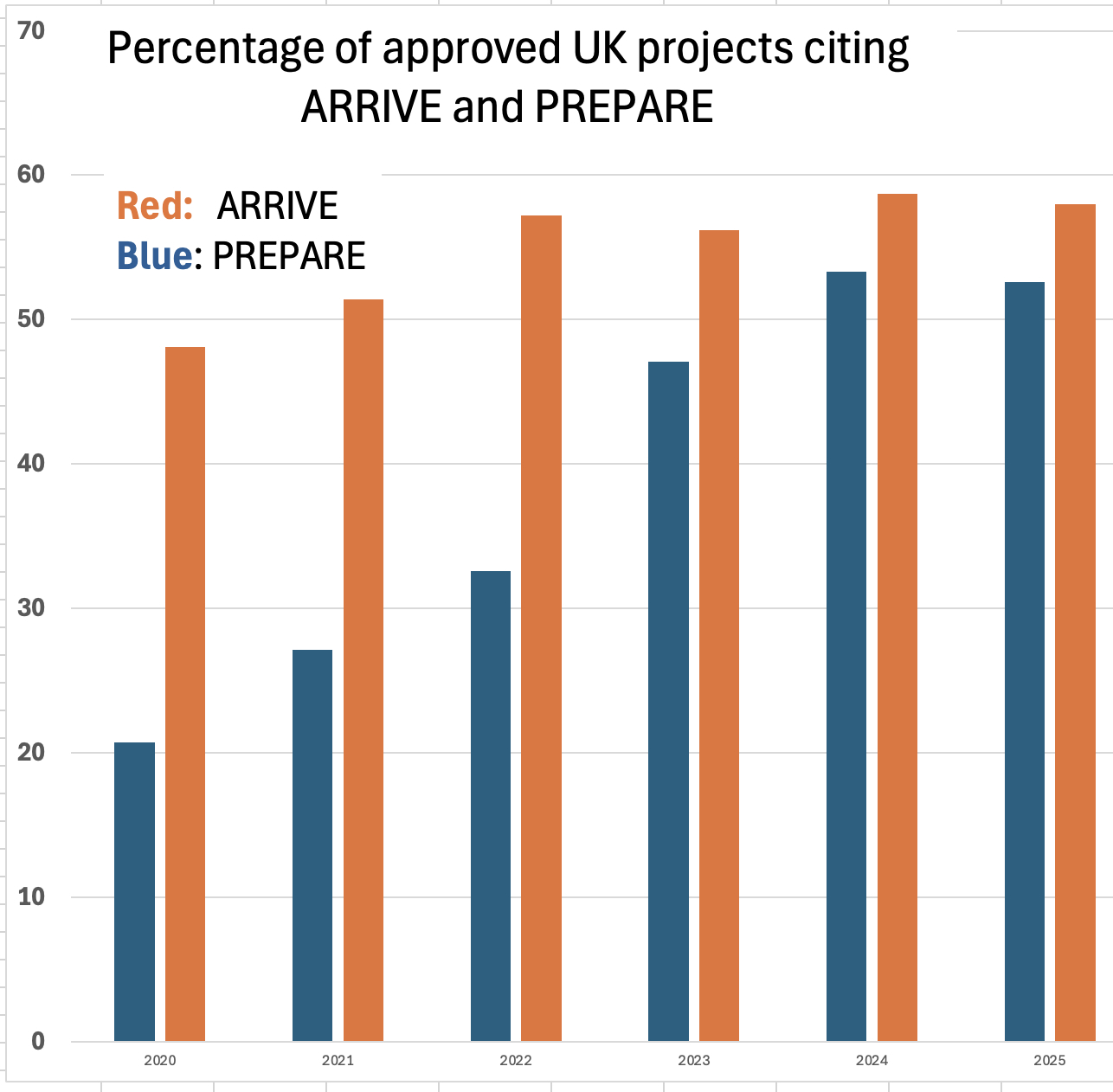
From 2020 the UAR has noted that many signatories had begun to mention that they follow Norecopa's
PREPARE guidelines, which were published in 2018. PREPARE provides a framework for ensuring that experimental design and data collection will support the requirements of reporting guidelines such as
ARRIVE which are often cited by journals. This last year, 37% of signatories endorsed and actively supported both ARRIVE and PREPARE.
Norecopa has analysed the UK Non-Technical Summaries (NTS) for all approved projects from the beginning of 2020 until the most recent ones available (up to and including September 2025). The use of ARRIVE and PREPARE is shown in the figure.
|
|
Alexandra Schnell and colleagues have just published an updated
assessment of sentience in cephalopod molluscs.
Kévin Dhondt is first author of an important chapter in the book
Pathology of the Laboratory Rabbit, where they discuss study design, regulations and ethics for this demanding species. He is also well known for his work at Charles River in introducing
human habituation programmes to reduce stress and aggressive behaviour.
Brendan Barrett and colleagues have published what they describe as
a failed error culture in biologging. They argue that the rapid growth of biologging is outpacing ethical and methodological safeguards, and a lack of error culture is causing repeated mistakes. They urge the research community to act to ensure sustainable and rigorous biologging practices.
Paul McGreevy and coworkers have published the
COMPASS guidelines for conducting welfare-focused research involving behaviour modification of animals.
An updated version (January 2026) has been published of the
Guidelines for the ethical treatment of nonhuman animals in behavioural research and teaching. The Guidelines are endorsed by both the Association for the Study of Animal Behaviour (ASAB) and the Animal Behavior Society (ABS), and are used by the Ethics Editors and reviewers of the journal
Animal Behaviour.
LitSuggest is a web-based system for biomedical literature recommendation and curation. Advanced machine learning and information retrieval techniques are utilised for finding and ranking relevant publications. After a model is trained, it can be automatically scan the literature for new publications.
VICT3R is a private-public partnership aiming to reduce animal use in toxicology research by developing virtual control groups.
We emphasise that Norecopa does not have vested interests in the resources mentioned in its newsletters, unless explicitly mentioned.
|
|
Professor emeritus Tore Midtvedt, Karolinska Institute, passed away on 2 December. After studying medicine in Norway and holding positions at both the University and Rikshospitalet in Oslo, he became Professor in Medical Microbiological Ecology in Stockholm, where he pioneered the use of isolators to raise germ-free research animals. His work had an enormous influence on the perception of the many roles of gut
microbes, procedures for studying these in the laboratory and the development of isolator technology.
Sophie Rotter and colleagues discuss the importance of
confirmatory multi-laboratory studies in strengthening preclinical research. They describe the results of a four-year funding period and workshop, and highlight common pitfalls and other lessons learned. They recommend many guidelines for quality management, including
GLP (Good Laboratory Practice),
PREMIER,
EQIPD and Norecopa's
PREPARE guidelines.
Guillaume Pavlovic and colleagues point out that
a better understanding of laboratory animal genetics improves reproducibility.
Does AI have an innate bias against animal welfare? Tse Yip Fai and Peter Singer have written a chronicle about this.
In a blog, Stefano Gaburro describes
the Validation Paradox of preclinical research, caused by the fact that the human data required for validation is largely unavailable.
Miriam Zemanova and Sylvia Frey report from
the annual meeting of the Swiss-based foundation
Animalfree Research, where they conclude that the transition to animal-free science is as much a cultural and ethical endeavour as it is a scientific one.
In
a comment in ALTEX, Thomas Hartung discusses the importance of the
UK's Roadmap for development, validation and uptake of alternatives (see also a
press release) and how to make it work. In a commentary in December, he claims that 2025 was a cross-Atlantic turning-point for work to phase out animal testing, but that this highlights
'the importance of being earnest', not merely ernest.
Vivian Johann and colleagues have examined
the emotional impact on cat and dog owners of veterinary medical errors. Some of these considerations may be of interest to those concerned about compassion fatigue and emotional labour in research animal environments.
On a brighter side, Jayne Orr and colleagues demonstrate that clinical‐year veterinary students are most likely to be confident and competent
in calving procedures after blending simulator practicals with videos.
|
|
Innstillingen fra Næringskomitéen på 6 millioner for 'å styrke arbeid med alternativer til dyreforsøk', ble vedtatt under Stortingets budsjettmøte fredag den 19. desember. Pengene er gitt til Veterinærinstituttet, som har ansvaret for Norecopas ene stilling fra før. Dette var i tråd med
innstillingen hvor det sto:
Komiteens flertall, medlemmene fra Arbeiderpartiet, Sosialistisk Venstreparti, Senterpartiet, Rødt og Miljøpartiet De Grønne, viser til budsjettforliket og Innst. 2 S (2025–2026) der bevilgningen på kap. 1135 post 50 foreslås økt ytterligere med 6 mill. kroner for å styrke arbeidet med alternativer til dyreforsøk.
Bevilgningen kan brukes til realisering av et norsk 3R-senter, dersom det samlet sett gir fornuftig ressursbruk av disse midlene.
Bevilgningen ble nevnt i talen til Une Aina Bastholm (MDG) under
budsjettbehandlingen:
'President, dyrene er også budsjettvinnere når Miljøpartiet Det Grønne får hånda på rattet og det er jeg stolt av ... vi har fått på plass 6 millioner ekstra til arbeid med alternativer til dyreforsøk som vi håper kan endelig realisere et permanent 3R-senter i Norge sånn som andre europeiske land har, altså et kompetansenter som
gir veiledning til forskere som vil bruke levende dyr og fisk i forsøk, for å unngå og minimere lidelse'.
Som nevnt i Norecopas
forrige nyhetsbrev er det ønske fra Norecopas side om å involvere alle landets forsøksdyrvirksomheter i arbeidet med å styrke satsingen på 3R. Dette ble formidlet til LMD da Norecopa presenterte sitt syn på saken i forbindelse med
evalueringen som LMD foretok i oktober og november, da Mattilsynet, Forsøksdyrkomitéen, Havforskningsinstituttet, Veterinærinstituttet og Norecopa ble invitert til fysiske møter.
I forbindelse med invitasjonene opplyste LMD om at evalueringen skulle bli ferdig innen 20. desember (mandatet). Det er ikke blitt offentliggjort noen rapport.
LMD har uttalt at det ikke vil bli holdt ytterligere hørings- eller dialogmøter i den videre prosessen. Norecopa håper at arbeidet med å utvikle et fullverdig 3R-senter kan fortsette gjennom konstruktiv dialog og engasjement hos alle partene, til beste for saken. Tildelingen
gjelder kun 2026, så det som skjer de neste årene vil sikkert bli påvirket av erfaringene fra i år.
Vi kommer tilbake til saken i de neste nyhetsbrevene når det foreligger mer informasjon, når LMD har sendt sitt tildelingsbrev til Veterinærinstituttet. NFD har allerede sendt sitt tildelingsbrev, hvor det står:
'I samarbeid med Havforskningsinstituttet skal Veterinærinstituttet sikre en helhetlig kunnskapsutvikling på dette feltet. Dette inkluderer forskning om hvordan man kan
erstatte, redusere og forbedre dyreforsøk (3R – Replace, Reduse, Refine)'.
|
|
Please help us in this task by forwarding this newsletter to friends and colleagues who may wish to subscribe. The white box at the bottom right of every page on Norecopa's website, or this link can be used.
|
|
|
Earlier editions of Norecopa's newsletter can be read here. They were published in Norwegian up to no. 2-2017. Free text searches on
Norecopa's website will also find resources which we have described in newsletters.
Mention in these newsletters of an institution, publication, professional service or opinion on animal research and testing does not necessarily mean that Norecopa endorses the activity or opinion. Norecopa and its staff are not involved, financially or otherwise, in the external activities mentioned here, unless this is explicitly
stated.
|
|
Content:
Norecopa
Editor:
Adrian Smith
Org.no. 992 199 199
Bank account: 2801.53.03931
Vipps: 889149
All photographs in the newsletters have been taken by Norecopa or from
colourbox.com, unless otherwise specified.
You can read about
Norecopa's data protection and privacy policy here.
In compliance with the EU Data Protection Regulation (GDPR), Norecopa updated its personal data and privacy policy in 2018.
You can read about this here.
|
|
|