|
Newsletter no. 2-2026 from Norecopa
Welcome to Norecopa's second newsletter of 2026. This is the 133rd newsletter which we have issued.
We hope you find them of use. We
welcome feedback, positive or negative.
Please share this newsletter with your colleagues and friends, and encourage them
to subscribe!
We are also on
LinkedIn and (to a much lesser extent) on
Facebook.
This newsletter contains the following items (if some links do not appear to work, check that your mail program has opened the whole of the newsletter):
|
•
|
|
|
•
|
|
|
•
|
|
|
•
|
|
|
•
|
|
|
•
|
|
|
•
|
|
|
•
|
|
|
•
|
|
|
•
|
|
|
•
|
|
|
•
|
|
|
•
|
|
|
•
|
|
|
|
The response to our new webinar series in 2026, in collaboration with Rafael Frías of
R3FINED International, has been overwhelming, and each of the first three webinars has been fully booked: 1,000 registrants. These receive a link to the recording, in case they cannot be present on the day. Recordings are not available for others, so we recommend early booking.
More information about the webinars
is available here. The latest event was a presentation by Lynne Sneddon on 13 March, who spoke on
Welfare in Laboratory Fish: From Assessment to Euthanasia.
The next webinar will be on 9 April when Bernhard Voelkl speaks on
Designing Robust Animal Experiments: Embracing Biological Variation to Improve Validity and Translatability.
Details of the webinars in May and June, both with internationally recognised experts in their fields, will be posted on
the webinar website soon.
|
|
The German Federal Ministry of Food, Agriculture and Consumer Protection (BMLEH) is awarding its Animal Welfare Research Prize in two categories for 2026, one of which is the
Animal Welfare Research Prize
for outstanding research achievements based on the 3Rs. The nomination deadline is
31 March. Norecopa was awarded their Prize last year for 'social and civic engagement in the field of laboratory animals', but this Prize is not being awarded in 2026.
Sponsored by GSK, the NC3Rs has announced its annual international 3Rs Prize of a £28,000 grant and a £2,000 personal award. The Prize recognises both emerging and established models, tools and technologies to advance the
3Rs. The centre welcomes applications from across academia and industry, and spanning the medical, biological and veterinary sciences.
Nominations must be delivered by 4 May.
The UK Animals in Science Committee has unveiled their new
Ways of Working protocol to support the development, validation and uptake of alternatives.
The RSPCA has published an
Action Plan for Avoiding and Replacing Animal Use for companies in the pharmaceutical sector.
FELASA has launched its
Sharing-Information Platform for Rehoming. The Platform offers species-specific guidance and experiences on (among other topics) socialisation protocols, SOPs on preparing the animal to the outside world, transport conditions, screening of suitable homes, and follow-up systems after rehoming. More guidance is available
here in PREPARE.
The Share-It 3Rs project in Cardiff is
collecting information on animal and tissue sharing. They invite colleagues to
complete a questionnaire by 31 March.
A UK report entitled
From models to medicines: A landscape review of human-relevant pre-clinical model development in the UK reveals a significant ‘translational readiness gap’ between predictive models developed in academic settings and what pharmaceutical companies need to develop effective medicines. Currently, about 10 per cent of medicines
research and development programmes eventually result in an approved medicine, with a lack of sufficiently predictive methods for identifying treatments at the pre-clinical stage seen as the main technical bottleneck in drug discovery.
The Report from the
5th UK Focus on Severe Suffering meeting, held last November, is now available, where experts shared refinements that have significantly reduced animal mortality across multiple research areas.
The UK Animals in Science Committee has published
a Support Note for the national network of AWERBs (UK animal welfare and ethical review bodies), which in turn is based on regional "hub" AWERBs. The guidance should be of interest for all those working with networks of animal welfare bodies. There is also now a European organisation for those countries that have such networks, ENAWB, for which Norecopa hosts the
website (norecopa.no/ENAWB).
The RSPCA have also updated their
Guiding Principles on Good Practice for AWERBs.
The US
Animal Welfare Institute has published
Refinements for Rodents and Rabbits in Research Institutions, a synthesis of the last 15 years of research on welfare improvements. Chapters include social housing, environmental enrichment, abnormal behaviour, human-animal interaction, colony management, and transportation. The book cites the
three-finger scruff technique described by Norecopa and
documented by Rachael Labitt and colleagues (we are aware that scruffing is increasingly being replaced by
less invasive handling methods).
There are many meetings and webinars on Norecopa's
International Calendar. Among those in the coming months are:
• The
European Academy of Lab Animal Surgery (EALAS) is holding its second international
Congress and workshops in Aachen on 15-17 April. This event intends to enhance surgical outcomes and animal welfare, foster interdisciplinary collaboration and promote global standards and best practices.
Among the many other events are:
•
IAT Congress in the UK in March
•
Scand-LAS in Copenhagen in May
•
CELASC (Central-East European Laboratory Animal Science Congress) in Budapest in June
ESLAV-ECLAM Summer School on Anaesthesia and Analgesia in July.
Norecopa is represented at three of these four meetings and is giving presentations at IAT and CELASC.
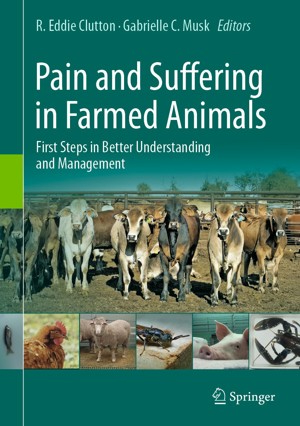
Eddie Clutton and Gabrielle Musk have published
Pain and Suffering in Farm Animals (cover photo), a welcome addition to the literature. Norecopa is compiling
a collection of resources for these species and welcomes suggestions for further additions.
The Insect Welfare Research Society has developed guidelines, both for the
Care and Use of Insects in Research and for the
Care and Use of Decapods in Research.
Markus Seeger and Johannes vom Berg, winners of the University of Zurich 3R Award in 2025, have made an excellent
YouTube video explaining how their Flycodes technology can reduce the number of mice needed by testing multiple antibodies simultaneously in a single mouse, while improving data quality at the same time.
Members of nine organisations have established a working group on
Communication in Animal Research, whose mandate is to develop a plan to facilitate communication within research institutions and also external communication with the public.
AstraZeneca have established
SIRF (Sex Inclusive Research Framework), providing guidance to researchers in designing preclinical research. The evaluation lead to one or more “traffic light” outcome classifications, indicating whether a proposal is appropriate, carries some risks, or is insufficient with regards to sex inclusion. The NC3Rs have
a blog about this. There is now a COST Action (EU-SABV) on this subject, and the US NIH have produced
Reviewer Guidance to Evaluate Sex as a Biological Variable.
|
|
Since the last newsletter on 26 January, Norecopa's Secretary has served on the Scientific Committee of the
Austrian 3R Days which will be held in Vienna in April (where he will also give a presentation).
The draft of Norecopa's Annual Report for 2025, written in English, has been approved by the Board, and is currently being translated into Norwegian. When the Accountant has delivered his Report it will be
published and described in the next newsletter.
|
|
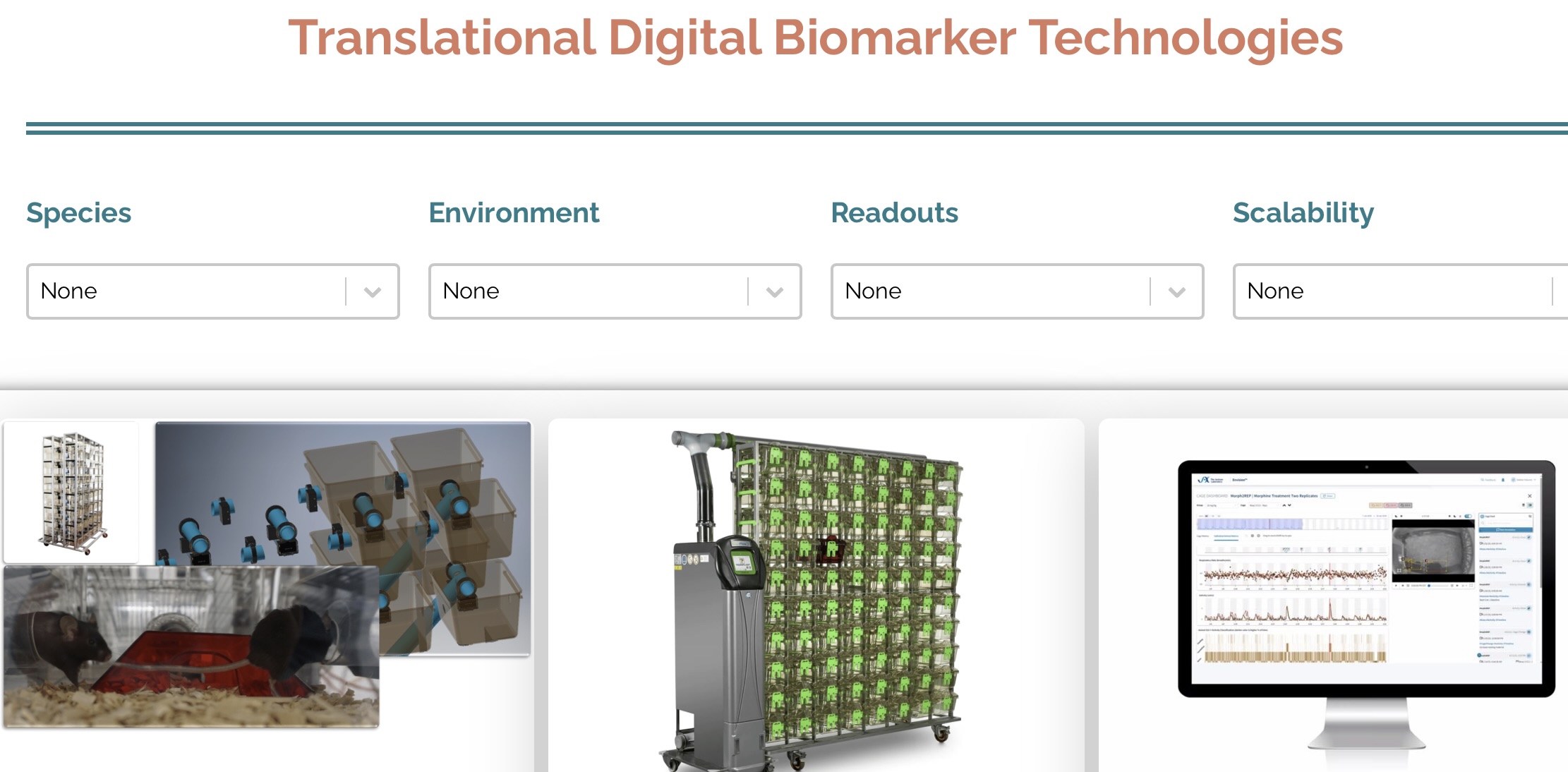
The
3Rs Collaborative has developed a
Translational Digital Biomarkers Portal.
These biomarkers are objective, quantifiable physiological and behavioural data, collected and measured by means of digital technologies. They can be internal (e.g. injectable or ingestible) or external (e.g. wearable, a camera, or an electromagnetic field detector). They have the potential to help reduce the number of laboratory animals needed for biomedical research and refine their lives during
necessary projects.
|
|
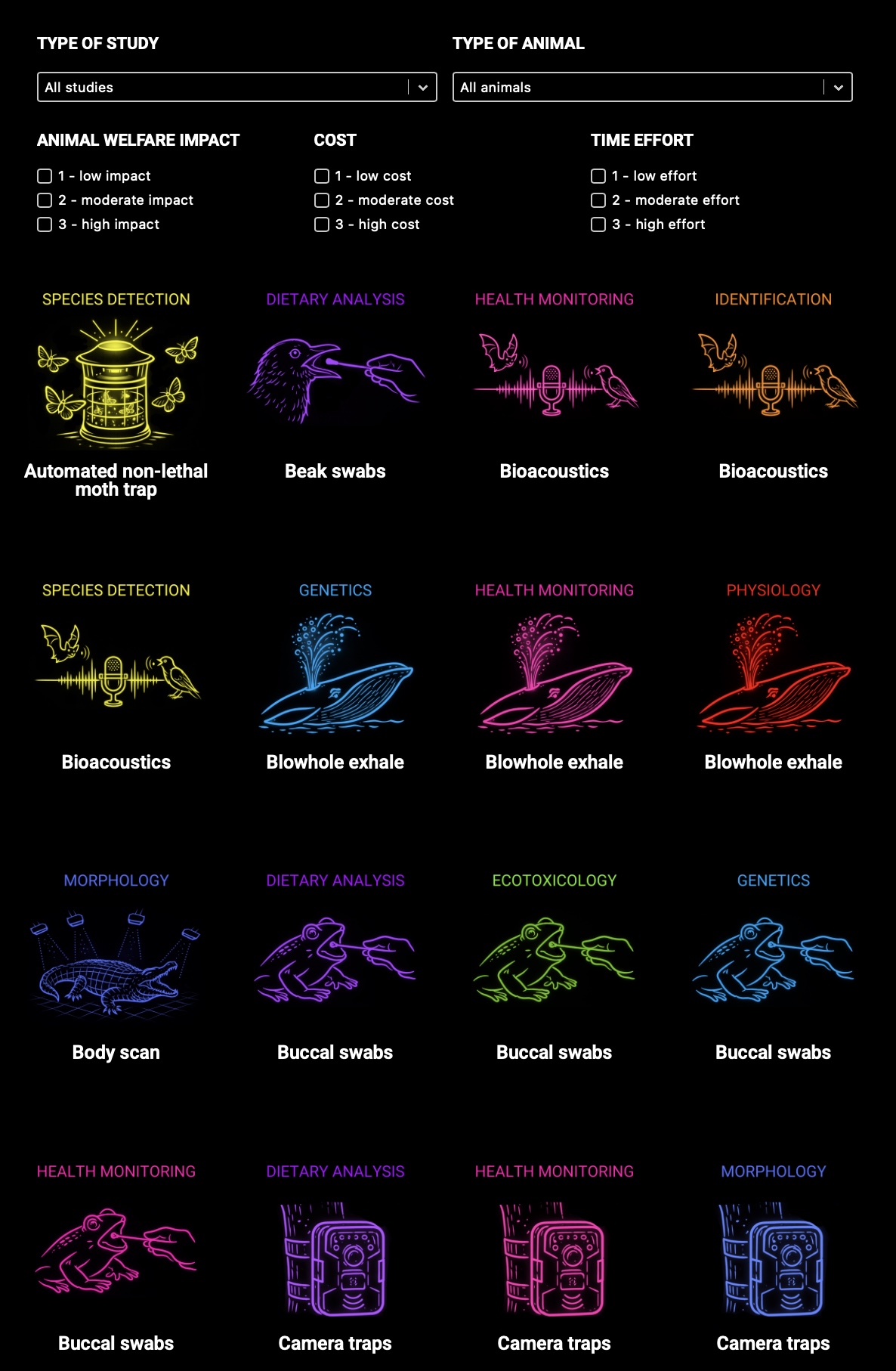
Miriam Zemanova, compiler of the 3Rs Wildlife website, has constructed a Method Finder which can be used by wildlife researchers to help identify suitable non-invasive or minimally invasive methods. They can be filtered by type of study, species, acceptable level of impact, cost and time effort.
|
|
Gianluca Riccio gives a balanced answer to the question
Goodbye animal testing? with a map of what in his view will disappear and when.
How and should sex differences be considered when planning
in vitro studies that model neurological disorders? Laura Castro-Aldrete and colleagues
address these questions.
Nicole Kleinstreuer and coworkers have
examined the replicability of a range of
in vivo toxicological guideline studies which are used as standards when evaluating New Approach Methodologies (NAMs). The results were poor, and the reasons are discussed. This suggests that we should re-examine the validation criteria being used for NAMs.
Shaun Killen and colleagues discuss why
the influence of social context is not considered as often as environmental factors such as temperature, when studying animal physiology.
Should animals be used for teaching in undergraduate or Masters/Diploma degree programmes? Dave Lewis of Leeds University asks University faculty, teachers/educators, researchers, technicians and anyone otherwise involved in university teaching
to share their views in a short survey.
Lab animal veterinarian Larry Carbone has written extensively about the fate of research animals and in a recent interview comments upon
how animal suffering can ruin experiments. He is the author of
What Animals Want: Expertise and Advocacy in Laboratory Animal Welfare Policy and a new book called
The Hidden Lives of lab animals: A Vet's Vision for a More Humane Future.
'Block what you can and randomize what you cannot'. Quoting Joan Box and colleagues, Penny Reynolds has written an excellent paper on
Experimental Designs for Preclinical Neuroscience Experiments, which is actually relevant for many more areas of science.
Georgia Mason has written a paper on
the crucial importance of construct validity when assessing laboratory animal welfare.
Where will the FDA Roadmap to reduce animal testing in preclinical safety studies lead us? Michael Fossler and Edwin Garner provide an answer to that question.
Quoting Norecopa's
PREPARE guidelines, Y. Sun and colleagues emphasise the importance of proper
planning in orthopaedic research, pointing out the importance of 'essential but often unreported details, such as virtual surgical planning, preoperative rehearsal, disinfection protocols, intraoperative management, postoperative support, multidisciplinary collaboration, and research documentation'.
The UK Animal Sentience Committee points to
differences in the definition of ‘animals’ in UK legislation. These discrepancies are not only unjustifiable on scientific grounds, but they have welfare implications.
In an editorial,
Nature Methods discusses
using AI responsibly in scientific publishing.
Is scientific reform an unwinnable arms race? Marcus Munafò and George Davey Smith give their thoughts.
Stephanie Borgland explains why
animals are still needed for discoveries in mental health research.
SAO (Science Advancement and Outreach), a division of PETA, has compiled a collection of Reflections on the current state of animal use in research, including an opinion piece by Kati Betrand where she claims that
the 3Rs fail to protect animals in research, and one by Gabby Vidaurre who claims that
humanising mice fails to solve the translatability problem.
On 28 January, the British House of Commons debated the figures from the regulatory authorities
concerning non-compliance.
Damien Huzard has written a commentary about the use of
Virtual Control Groups as an alternative to a new set of controls in each experiment.
Florian Frommlet and colleagues
assessed the quality of over 300 applications for preclinical animal experiments submitted to the Medical University of Vienna, and found considerable room for improvement.
Professor in neurosurgery Nanthia Suthana considers that
neuroscience has a species problem.
Orthopaedic surgeon and journal editor Seth Leopold has had
a conversation with philosopher and ethicist Peter Singer. Leopold has previously written
an Editorial on preclinical orthopaedic research, to which Norecopa's secretary
responded.
Are you lost in NAMs-lation? Donna Macmillan, Phi Holcomb and Kristie Sullivan review the definitions. Norecopa has made
a collection of such opinion pieces here.
|
|
Italian scientist
Stefano Gaburro has recently written a large number of thought-provoking blogs on LinkedIn about current topics in animal research and testing. These include (arranged roughly by topic):
•
The Future of Animal Research is not Replacement. It is Biological Relevance
•
The Future of Animal Research in 2030: Beyond the Binary Debate
•
The Future of Animal Research will not be Decided by Slogans
•
We Are Allowed to Defend Animal Research. We Are Not Allowed to Keep Communicating It the Same Way
•
The Proven Worth of Animal Experiments. And Why Defending the Status Quo Is No Longer Sustainable
•
The Arithmetic of Animal Use: What
One Human Lifetime Actually Costs
•
The 95% Drug Failure Rate: What's Really Going Wrong (And It's Not What
You Think)
•
A Bold Vision Or an Ambitious Gamble? The UK's New Strategy to Replace Animal Testing in Science
•
Everyone talks about organoids replacing animal research
•
Human-Derived Does Not Mean Human-Relevant: The Inconvenient Biology Behind NAMs
•
Human-Derived Does Not Mean Human-Relevant: The Inconvenient Biology of Unphysiological Culture
•
Derisking, Not Proving: The FDA/CDER Perspective on Nonclinical Studies and the Real Opportunity for NAMs
•
Qureator’s IND Breakthrough: Advancing Human Models Without Ending Animal Research
•
The Right Light Conditions in the Modern Vivarium for Laboratory Rodents
•
White Noise or Radio? What
Science Reveals About Sound in Animal Home Cages
•
The Endgame Is Closer Than You Think: Scientific Publishing in the Age of Autonomous Research
•
Beyond the False Dichotomy: A Credible Transition Plan for Preclinical Research
•
Beyond Predictive Validity: Why "Context of Use" Changes Everything in Preclinical Model Selection
•
Biologically Relevant Models: Why Context of Use, Not Technology Type, Should Drive Preclinical Science
•
Europe is Quietly Defunding Its 3Rs Infrastructure. The Consequences Will Not Be Quiet*.
*Please note that efforts are being made to restart the Danish 3R Centre which this blog mentions in detail - but with differerent funders.
In a comment to a posting by Stefano Gaburro, the chief veterinarian at Charles River Laboratories, Kévin Dhondt, explains why the company invests both in acquisition of a non-human primate supplier and in a next-generation sequencing
company that replaces some animal-based viral screening.
Gaburro
makes a similar point in a separate posting, where he writes:
'The 3Rs are no longer just about replacement. They are about integration:
• Integration of NAMs with animal models
• Integration of engineering, biology, data science
• Integration of welfare, scientific validity, and regulatory credibility
If you still frame the debate as animals versus alternatives, you are already behind.
What
EU3Rnet quietly demonstrates is something deeper. Europe is building capacity, not ideology. Capacity to test, validate, compare, fail, iterate, and translate.
If you want impact in this space, stop asking who replaces whom.
Start asking who connects what, and under which evidentiary standards'.
|
|
Som omtalt i
det forrige nyhetsbrevet, bevilget Stortinget 6 millioner på 2026-budsjettet for 'å styrke arbeidet med alternativer til dyreforsøk. Bevilgningen kan brukes til realisering av et norsk 3R-senter, dersom det samlet sett gir fornuftig ressursbruk av disse midlene.'
LMD har nå sendt
sitt tildelingsbrev datert 29. januar til Veterinærinstituttet. Der står det:
'Som et ledd i oppfølgingen av dyrevelferdsmeldingen tildeles Veterinærinstituttet 3 mill. kroner for 2026. Midlene skal benyttes til en helhetlig kunnskapsoppsummering om alternativer til dyreforsøk og arbeid med 3R i Norge i samarbeid med relevante
aktører. Konkrete føringer for oppgaven vil komme i et eget brev på et senere tidspunkt.'
I skrivende stund har ikke Veterinærinstituttet fått det varslede brevet, og heller ikke noen forklaring på hvorfor det kun er nevnt 3 millioner i tildelingsbrevet.
Veterinærinstituttet presenterte sin årlige
Fiskehelserapport i Bergen den 12. mars.
Rapporten presenterte statistikken for forsøksfisk brukt i 2024. Den refererte også til omtalen i Dyrevelferdsmeldingen, med følgende forslag til forbedring: standardisering/registrering av velferdsindikatorer, og konkretisering av 3R-tiltak for å samle og
tilgjengeliggjøre kunnskap.
Veterinærinstituttet påpeker at meldingen nevner at 'en felles nasjonal plattform for uformell publisering av dyreforsøk vil kunne fremme deling av erfaringer og resultater', uten at det er konkretisert hvem som skal ta initiativet og kostnadene.
Mattilsynet skal utarbeide
en ny forskrift for dyrevelferd for akvakulturanlegg, transport, slakterier og tilknyttede virksomheter. Målet er å samle og oppdatere regelverket i en forskrift som vil gjelde fra januar 2027. Mattilsynet vil innhente innspill fra næringen, kunnskapsinstitusjoner, fagmiljøer, andre myndigheter og dyrevernorganisasjoner for å sikre et sterkt og praktisk
regelverk, bl.a. med en åpen høring i juni-september.
Adrian Smith holdt et foredrag for
Norsk Veterinærhistorisk Selskap i Oslo den 3. mars. Det var
en personlig og usminket beretning av hans opplevelser i det norske forsøksdyrmiljøet de siste 40 årene.
|
|
Please help us in this task by forwarding this newsletter to friends and colleagues who may wish to subscribe. The white box at the bottom right of every page on Norecopa's website, or this link can be used.
|
|
|
Earlier editions of Norecopa's newsletter can be read here. They were published in Norwegian up to no. 2-2017. Free text searches on
Norecopa's website will also find resources which we have described in newsletters.
Mention in these newsletters of an institution, publication, professional service or opinion on animal research and testing does not necessarily mean that Norecopa endorses the activity or opinion. Norecopa and its staff are not involved, financially or otherwise, in the external activities mentioned here, unless this is explicitly
stated.
|
|
Content:
Norecopa
Editor:
Adrian Smith
Org.no. 992 199 199
Bank account: 2801.53.03931
Vipps: 889149
All photographs in the newsletters have been taken by Norecopa or from
colourbox.com, unless otherwise specified.
You can read about
Norecopa's data protection and privacy policy here.
In compliance with the EU Data Protection Regulation (GDPR), Norecopa updated its personal data and privacy policy in 2018.
You can read about this here.
|
|
|