|
22 September 2026
Newsletter no. 5-2026 from Norecopa
Welcome to Norecopa's fifth newsletter of 2026. This is the 136th newsletter which we have issued.
We hope you find them of use. We
welcome feedback, positive or negative.
Please share this newsletter with your colleagues and friends, and encourage them
to subscribe!
We are also on
LinkedIn and (to a much lesser extent) on
Facebook.
This newsletter contains the following items (if some links do not appear to work, check that your mail program has opened the whole of the newsletter):
|
|
As mentioned in
Norecopa's previous newsletter in July, work has started to establish a national 3R Centre in 2027.
The Norwegian Food Safety Authority (Mattilsynet) will host the Centre and plans to advertise three full-time positions for this Centre this Autumn.
The magazine of
Animal Research Tomorrow has published
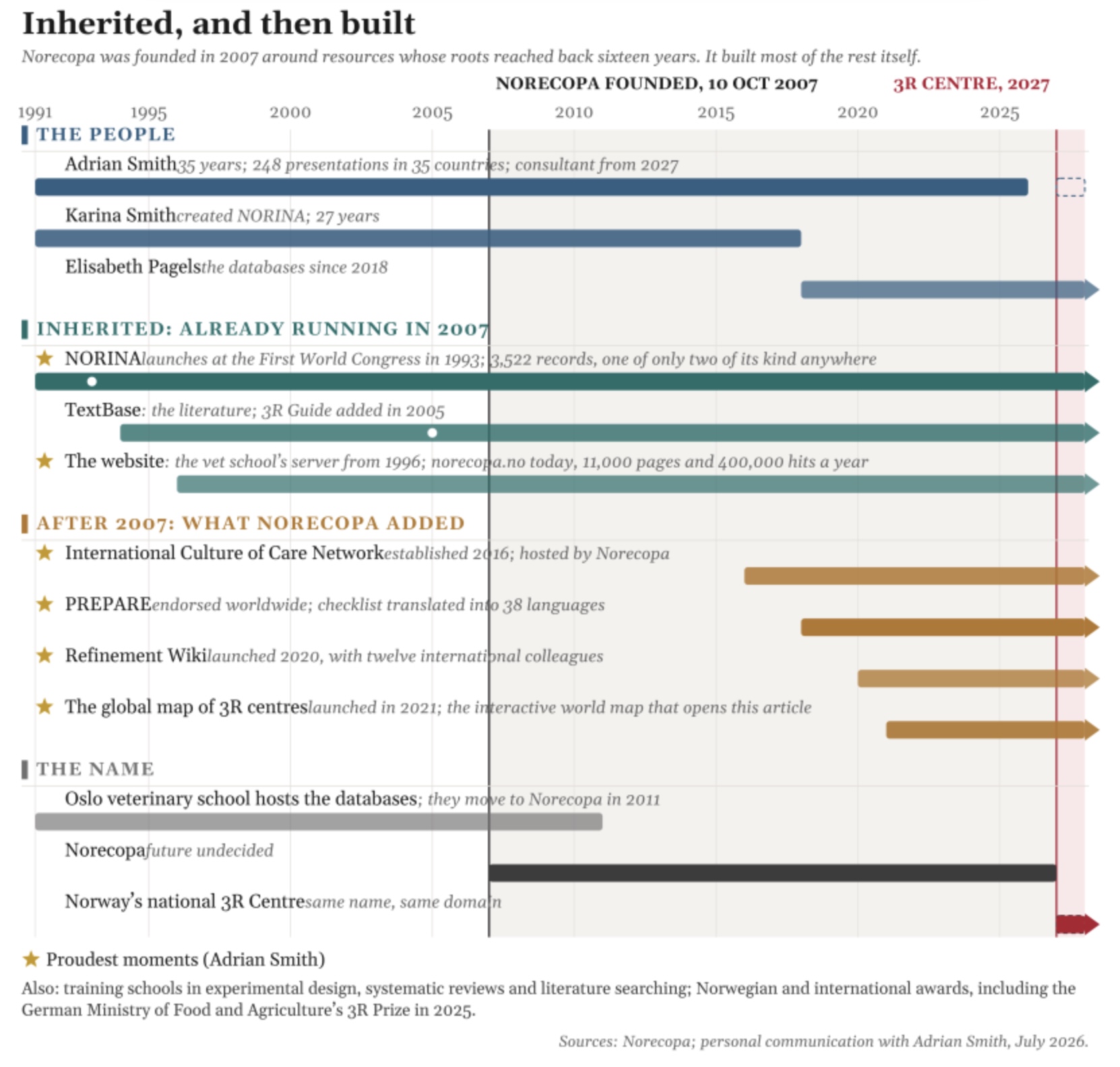
a history of Norecopa, with a timeline (see the illustration) depicting the events in the 1990s which led up to its establishment in 2007.
Norecopa's Secretary Adrian Smith will circulate details of these positions
via his LinkedIn feed as soon as they are announced, and in future newsletters from Norecopa.
On 26 August Adrian Smith held a presentation for the South African Association for Laboratory Animal Science entitled
Advice on how to search for alternatives, with emphasis on Replacement.
The highly successful monthly
webinar series, which Norecopa and R3FINED Ltd. started in January, continues to attract around a thousand registrations. There have been two webinars since the last newsletter: by Professor Eddie Clutton, Edinburgh University (Anaesthesia and Analgesia of Large Animals in Research - A Curated Q&A on Pigs, Sheep, Goats and Cattle) and Emeritus Professor Jeff Everitt, Duke University (Pathology and Biosampling to Support
Reproducible Animal Modelling). There will be three more webinars this year, and Norecopa plans to continue the series in 2027.
Norecopa is participating in the next webinar in a series arranged by the US National Academies for Science, Engineering and Medicine (NASEM) called
Global Dialogues on Laboratory Animal Science. This webinar, on 7 October, is entitled
Rigorous by Design: Strengthening Research That Involves Animals. Topics will include evaluating existing evidence before initiating new studies; using planning tools such as Norecopa's
PREPARE and the NC3Rs
Experimental Design Assistant; accounting for key biological variables, including sex as a biological variable; and applying reporting frameworks such as
ARRIVE 2.0 and
DRIVER.
|
|
Science for Animal Welfare (formerly UFAW) are
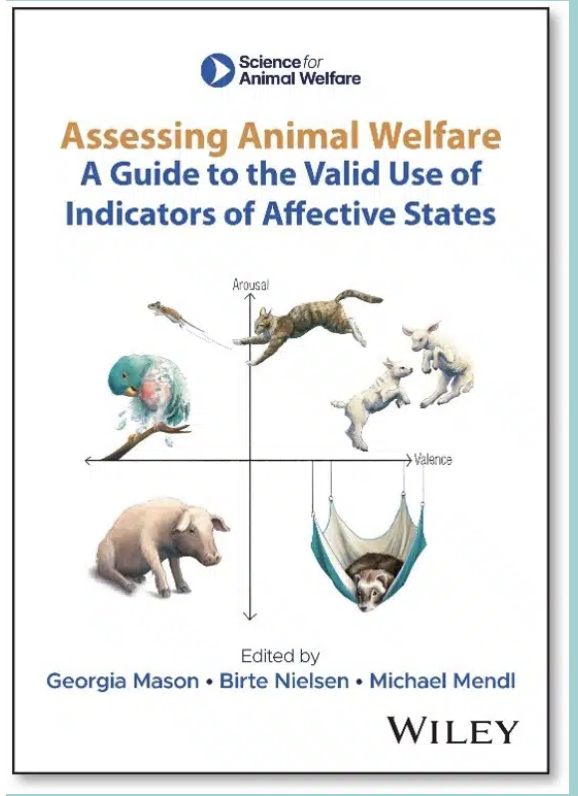
offering free e-copies of their book
Assessing Animal Welfare - A Guide to the Valid Use of Indicators of Affective States.
Applicants must be based in a low-income country and should be working in the animal welfare field, such as students, veterinarians, legislators, academics, or animal-related NGOs.
The deadline for applications is 15 November.
The
Animal Welfare Institute is accepting applications for two refinement funding opportunities:
•
The Refinement Research Award provides up to $15,000 to fund a research project aimed at developing or testing innovative methods of refinement to the care, husbandry, or housing of animals in laboratories to improve their welfare
•
The Implementing Refinement Grant provides up to $8,000 toward the implementation of a refinement (e.g. purchase of equipment or staff training) that will improve the welfare of animals in laboratories.
The deadline to submit an application is 11 October at 11:59pm Eastern Time.
The
Animal Welfare Sweden Research Foundation solicits applications for up to
SEK 250,000 for research projects, with a deadline of 20 September.
The
Research Fund of the Animal Protection Alliance (Dyrevernalliansen) is still open for applications, until 24 September.
Applications are open for a $100,000
Systematic Review Grant, funded by AAALAC International and administered in partnership with Science for Animal Welfare. They are seeking proposals for a rigorous systematic review that will strengthen the evidence base for best management practices and welfare recommendations for animals commonly used in research and teaching. The deadline is 1 November.
Animal Research Tomorrow has announced awards to support young science communicators and/or those creating tools for more transparent animal research. The deadline for submission is 30 October at 1600 CET.
|
|
Ten years on from their first report on the transition to non-animal research, the Netherlands National Committee (NCad) has
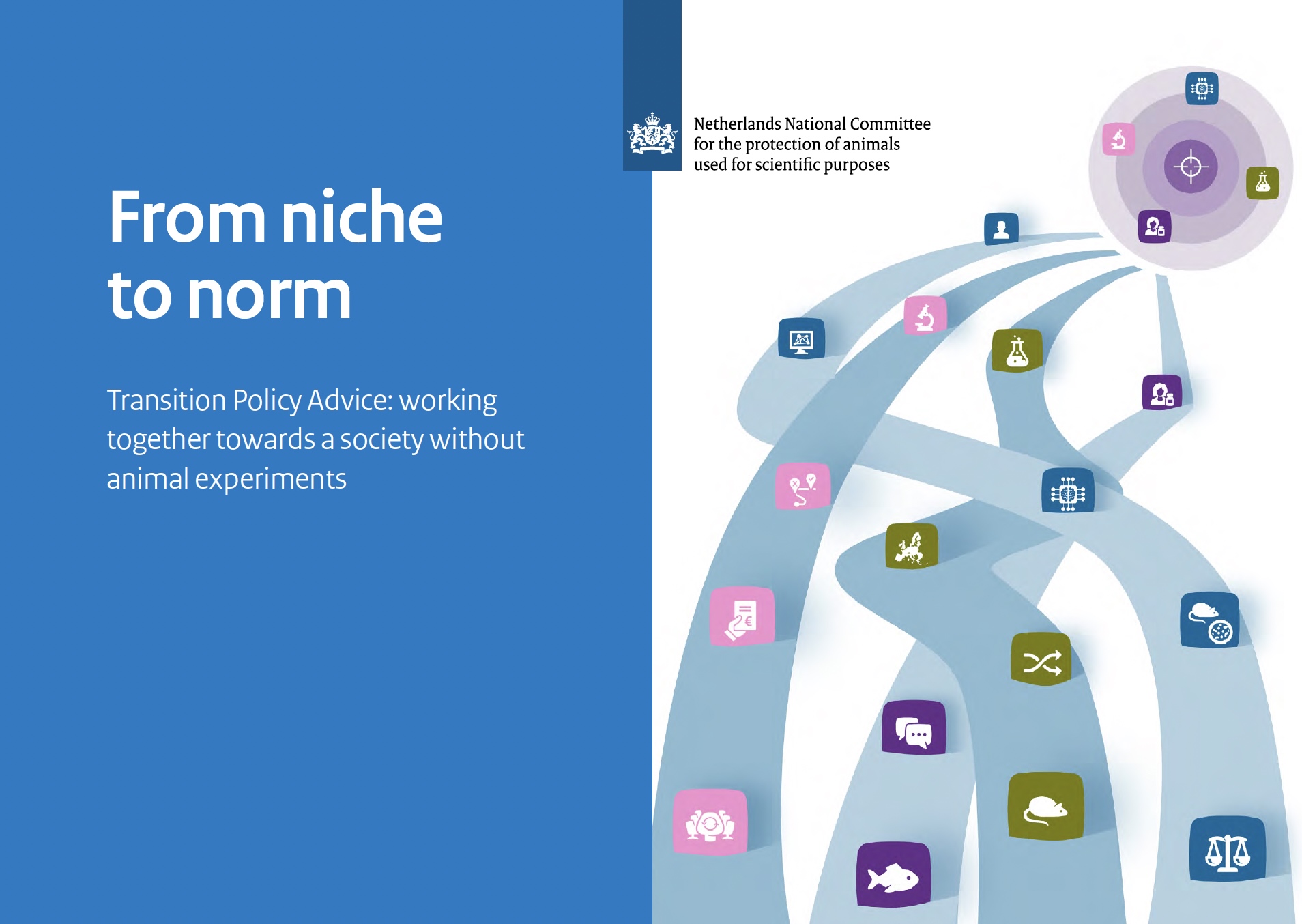
published a new advisory report on working together towards a society without animal experiments.
The transition 'requires coherent change across five pillars. Together, these form a pathway of change in which innovations can emerge and mature, be scaled up and institutionally embedded, and ultimately contribute to a society without animal experiments'.
The NCad recommends that Ministers
'consistently communicate a single shared core narrative: animal-free innovation achieves replacement not primarily by reproducing existing animal experiments one-to-one, but by transforming research questions, evidence strategies and science itself. Methods should be assessed on their relevance, reliability, societal significance and ethical justification, rather than against the animal model as an assumed standard'.
The NCad further recommends adaptation of 'existing data, material
and research infrastructures to support animal-free innovation. This should include safeguarding quality standards, interoperability, sustainable access to human-derived material, the reuse of both human data and historical animal data, shared core facilities, and secure forms of data visiting'.
In the foreword, the Committee Chair emphasises that 'transition towards a society without animal experiments involves more than technological innovation. It calls for an ongoing dialogue about
the public values that come together in this transition: health, safety, scientific quality, animal welfare, capacity for innovation, sustainable development and public trust. That judgement cannot and should not be made by a single party on its own. Researchers, administrators, politicians, businesses, civil society organisations and citizens each have their own role and responsibility...
Therefore, the success of the transition depends not only on new insights, but above all on our
willingness to adapt our institutions, ways of working and collaborative practices accordingly'.
This report joins other significant roadmaps that have been issued recently:
•
The UK strategy to support the development, validation and uptake of alternative methods, with specific target dates for some of these
• The
EU Roadmap towards phasing out animal testing for chemical safety assessments
• The
FDA Roadmap to reducing animal testing in preclinical safety studies, building on the
FDA Modernization 2.0 Act (2022) which refuted the 1938 Act mandating animal testing for every new drug development
•
A strategic roadmap issued by the
ICCVAM in the US to establish new approaches to evaluate the safety of chemicals and medical products
Similar strategies have been proposed in
Canada,
the Netherlands and
Sweden.
|
|
This is a direct quotation from a LinkedIn posting on 17 September from the
3Rs Centre in Utrecht:
A lot of research described as "in vitro" isn't fully animal-free. The cells may be of human origin, but many materials used to grow them often aren't. Well know examples are fetal calf serum (FCS or FBS), animal-produced antibodies, and basement membrane extracts (BME) such as Matrigel, Geltrex and Cultrex. The animals used to produce these Animal-Derived Products (ADP) remain ‘invisible’ in
registered experimental use, while their existence and suffering is real. At the 3RCU this is one of our focus points.
Last year we traced and quantified the 'invisible animal use' at the
Utrecht Science Park. We also developed practical publicly available, searchable databases to facilitate researchers in their efforts to replace
Foetal Calf Serum and
Basement Membrane Extracts, and host the international
ReALiSe working group bringing together stakeholders. And long time followers of our LI account may remember our
campaigns about the scientific arguments to stop using Animal-Derived Products.
Although many animal-free alternatives have been developed, their uptake remains limited. Researchers often don’t have the comparative data to be sure an alternative will perform the same way in their own system, and switching a reagent without that assurance means risking your results.
A recent report from the
NC3Rs shows what happens when that gap gets funded directly. A 2024 call invested £905k in ten projects aimed at characterising and validating animal-free reagents in routine use, covering recombinant antibodies, chemically-defined media and synthetic matrices. These projects produced performance data on more than 200 animal-free reagents and model components. The NC3Rs estimates that these results will enable replacement of thousands of animals a year. This work involved 18 academic and
industry partners and has
since drawn nearly £1M in follow-on funding.
|
|
This
live, interactive workshop is designed for laboratory animal professionals who already have some experience with rodent anaesthesia and want to deepen their understanding, refine current protocols, and explore the latest developments in multimodal pain relief. Organised by Professor Emeritus Paul Flecknell, it takes place on 9-10 November. It is part
of the
Research Animal Training (RAT) programme which he established.
Topics will include use of local anaesthetics, NSAIDs in mice, oral administration of analgesics, slow release buprenorphine, alternatives to ketamine/alpha2 combinations, and practicalities of monitoring anaesthesia in rodents - as well as topics from the pre-workshop questionnaire.
|
|
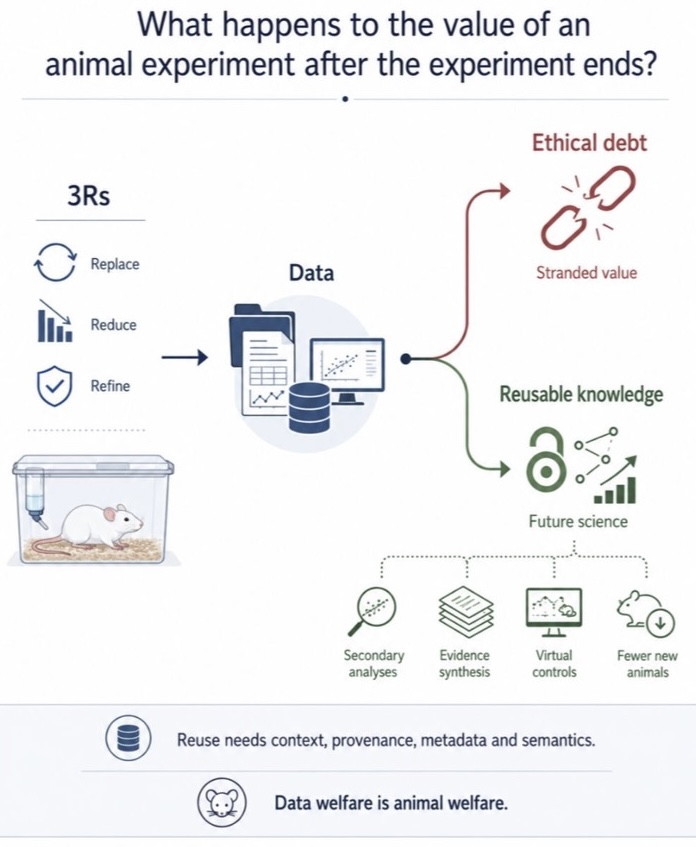
In a LinkedIn posting,
Damien Huzard asks what happens to the value of an experiment after the experiment ends? He shared an illustration which clearly describes the alternatives.
Sabine Bischoff and Florian Dehmelt discuss
the state of error reporting in animal research. They have a vision in which error reporting becomes both an internalised cultural practice and standard operating procedure, with employee wellbeing structurally embedded.
How can lessons from the Olympics be used to improve animal research? Norecopa has taken the initiative to enable
Open Access for an excellent paper by Elliot Lilley and Maggy Jennings on this subject. which was published in the
ATLA journal. We thank the publishers,
Sage, for agreeing to do this without charge.
Penny Reynolds and Esther Pearl discuss
reporting and transparency in laboratory animal science - looking at past achievements, present concerns and future directions.
'The Vets Who Make Animals Sick' is a headline on a website produced by the US animal rights organisation Rise for Animals. It refers to the work of lab animal veterinarian Larry
Carbone, who after working for decades wrote the book
The Hidden Lives of Lab Animals, A Vet's Vision for a More Humane Future. This is a topic about which all lab animal vets should have an opinion, and which other lab animal personnel should also discuss.
René Aquarius and colleagues looked for evidence of
image or data concerns in the preclinical literature on microvascular injury after acute myocardial infarction. Of 201 papers, 28% were deemed problematic.
Is the very structure of a scientific paper a fraud? John Tregoning
re-examines the question, 60 years after Nobel Laureate Sir Peter Medawar proposed the idea on BBC radio.
Nuno Franco discusses a neglected part of the ethics debate about animal research:
what changes when animals are used, at least in part, for the sake of other animals?
Purpose versus Pragmatism is part of the title of an upcoming paper on participant perspectives in the process of ethical review in Sweden.
Ji Min
Lee and colleagues
call for global standards for the post-experimental use and disposition of lab animals. They compare the situation in the EU, USA, UK and the Republic of Korea, and they offer a decision tree for reuse and rehoming. Myhailo Reshetnykov and coworkers
wrote a paper on the subject in 2025 He and Jan Baumgart have recently also presented decision trees for
managing the use of genetically burdened laboratory animal lines under EU Directive 2010/63.
Diego Celdran-Bonafonte and Petra Seebeck have written a paper about
the future of rodent surgical training in lab animal science. He also held an excellent
webinar on the subject on 15 September, highlighting the ways in which bioprinted simulators could be successfully used for the initial training.
Fernando Gonzalez-Uarquin and coworkers point out that
laboratory animal science cannot afford sex bias, and offer their thoughts on aligning the 3Rs with sex-inclusive research.
To celebrate 10 years of
the FAIR principles, submissions
are being requested for papers describing their use, to be published in Nature Scientific Data. The deadline is 14 November.
A paper by Nicolas Villarino (published in 2025) provides important
recommendations for a complete reporting of statistical methods in scientific papers. It is written from the viewpoint of veterinary pharmacology, but is relevant for other disciplines as well.
Why are AI tools so attractive and what are the risks of implementing them across the research pipeline? Lisa Messeri and Molly Crockett
discuss this, and the illusions of understanding in scientific research. Stefano Gaburro claims that
"AI or not AI" is no longer the question.
Stefano Gaburro and a large number of colleagues point out that
the debate about the use of NAMs versus animal models in drug development must centre on the context of use, and they argue for a patient-centered approach that combines animal and non-animal models.
Martijn van Velthoven and colleagues discuss
how to overcome 'difficult, impossible, and meaningless animal testing under REACH', describing opportunities for robust chemical risk assessment with non-animal approaches.
In the EU Commission's
Horizon magazine, Anthony King offers his views on
how AI could replace animal testing.
How do Large Language Models (LLMs) perform when using them to improve workflows and advance the 3Rs? Siegmund Lang and colleagues have performed
a scoping review to investigate this in connection with preclinical spine research.
Alexandra Schaffert and colleagues discuss the challenge of
finding a place for new approach methodologies in biomedical research.
Why is the uptake of animal study preregistration progressing relatively slowly? Pasquale Pellegrini and Ulf Toelch have investigated
the attitudes, barriers and myths about this in Switzerland. They cite a paper published the same week by Cristina Priboi and colleagues with
the results of a survey among researchers. On the same subject, Lena Kistermann and coworkers have performed
a feasibility study, comparing the German Animal Study Registry and Preclinicaltrials.eu, as a tool for refinement.
Anna Ratuski and colleagues interviewed Canadian scientists to shed light on
attitudes, experiences, barriers and solutions in the work of attempting to implement refinement in animal studies.
Bob Fischer and coworkers offer
ethical guidance for insect research.
Yingying Han has written a paper about
the legitimacy and ethics of the forced swim test in rodents.
Lucinda of
Replacing Animal Research (formerly FRAME) explains why
they are not impartial - and states that there is no such thing anyway.
How is Open Science practised worldwide, and which incentives can be used to increase its use? These questions were examined in
a survey across 45 countries and 24 disciplines.
Do you teach biostatistics and want to make it more interesting? Armando Teixeira-Pinto has created
a website of animations that illustrate some of the central topics.
In a light-hearted piece under the title
Life is pain, especially your data, Darren Dahly explains what a p-value is, in as few sentences as possible...
|
|
Forsøksdyrkomitéen har publisert en oversikt over
grunnleggende opplæringskurs (funksjon A-D) som tilbys i Norge høsten 2026.
Protokollen fra Norecopas årsmøtet den 11. juni
er tilgjengelig her. Kort oppsummert, Norecopa fortsetter som før, til tross for arbeidet med å etablere et 3R-senter, inntil Norecopas øverste organ (årsmøtet) eventuelt bestemmer seg for endringer.
Som omtalt i
det forrige nyhetsbrevet, er Mattilsynet i gang med å forberede utlysning av tre faste heltidsstillinger som skal bemanne Norges nye 3R-senter. Mattilsynet har fått 3 millioner i 2026 til å forberede oppstarten av senteret.
Norecopas sekretær Adrian Smith vil legge informasjon om disse stillingene ut på sin
LinkedIn side så snart de er offentliggjort, og i fremtidige nyhetsbrev fra Norecopa.
Veterinærinstituttet, i samarbeid med en rekke andre institusjoner som bruker forsøksdyr, har startet arbeidet med å følge opp LMDs bevilgning i 2026 på 3 millioner for å lage 'en helhetlig kunnskapsoppsummering om alternativer til dyreforsøk og arbeid med 3R i Norge i samarbeid med relevante aktører.' Arbeidet har en frist til 1. mai
2027. Dokumentet bør være et svært nyttig hjelpemiddel for det nye senteret.
Hva bør betraktes som innredning og hva fungerer som miljøberikelse for forsøksdyr? Sveriges nasjonale komité
definerer disse begrepene og illustrerer dem med eksempler hos 7 dyreartsgrupper.
Veterinærinstituttet har publisert
en podcast med Adrian Smith om Norges tiltak for å styrke arbeidet med alternativer til dyreforsøk. Podcasten er på 25 minutter og ble spilt inn rett etter Norecopas årsmøte i juni, derav en litt rusten stemme.
|
|
Please help us in this task by forwarding this newsletter to friends and colleagues who may wish to subscribe. The white box at the bottom right of every page on Norecopa's website, or this link can be used.
|
|
|
Earlier editions of Norecopa's newsletter can be read here. They were published in Norwegian up to no. 2-2017. Free text searches on
Norecopa's website will also find resources which we have described in newsletters.
Mention in these newsletters of an institution, publication, professional service or opinion on animal research and testing does not necessarily mean that Norecopa endorses the activity or opinion. Norecopa and its staff are not involved, financially or otherwise, in the external activities mentioned here, unless this is explicitly
stated.
|
|
Content:
Norecopa
Editor:
Adrian Smith
Org.no. 992 199 199
Bank account: 2801.53.03931
Vipps: 889149
All photographs in the newsletters have been taken by Norecopa or from
colourbox.com, unless otherwise specified.
You can read about
Norecopa's data protection and privacy policy here.
In compliance with the EU Data Protection Regulation (GDPR), Norecopa updated its personal data and privacy policy in 2018.
You can read about this here.
|
|
|